Reading room
The complete text of the Black Temple
No frames here, and no motion. Only what is written. On the shelf every chapter stands with its length and what is inside it. Take the one you came for, or read straight through.
- 13 chapters
- 35.380 words
- 161 min read
The shelf
-
I
Manifesto
The word before all words
In the Balkans the gods always arrived from elsewhere. This is the first one that did not.
- How a devil is made
- The god actually worshipped here
- The only sin this temple recognizes
- Inat and merak
- +5
-
II
Satanism, as it truly is
The name they gave us
What Satanism is once the horns come off: six principles, with a mirror instead of an altar.
- A word that was an accusation
- Nobody here believes in the Devil
- What a Satanist truly values
- Reason before authority
- +7
-
III
Lucifer is good
The lightbringer
How the one who brought the light ended up as the villain.
- A star, not a criminal
- How a star got a case file
- The fall as the price of light
- The Enlightenment under another name
- +2
-
IV
Who we are. Who we are not.
No fog
Who stands behind the temple, and how you can tell this is not a cult.
- We are
- We are not
- How a sect is recognized, and why we are not one
-
V
Why Veles?
The god they pushed underground
Why a Slavic god of cattle and the underworld, and not a flashier name.
- First, an honest disclaimer
- The god by whom words were sworn
- Everything that is genuinely written about him
- How a god becomes a devil
- +3
-
VI
Nine roots
Principles
Nine principles to live by. Commandments are issued from above; roots grow from below.
- The root of inat
- The root of merak
- The root of reason
- The root of obraz
- +5
-
VII
Symbols, the language that does not lie
Reality, drawn in a single line
Fourteen signs cut into stone: what each one means and where it comes from.
- The Mark of the Black Temple
- Marks cut into stone
- A stone that turns
- The shared language of the dark
- +1
-
IX
A Balkan dictionary of the sacred
Language is older than the church
Eighteen words that refuse to be translated, and carry a whole worldview.
- Inat
- Merak
- Ćeif
- Sevdah
- +14
-
X
The pantheon of shadow
Beings out of the dark, truths out of the mirror
Eighteen figures of our lore, and what they were before they were declared devils.
- Veles
- Vrag
- Crnobog and Belobog
- Morana
- +14
-
XI
Rituals as psychodrama
Theatre for a single spectator
Rites without the supernatural: what they are for, how long they take and what you need.
- Why a rite at all, if there is nobody to receive it
- The six levers of every rite
- Rites for every day
- Black coffee
- +15
-
XII
The calendar of Crni Hram
The wheel of the year
Thirteen nights of the year, where they come from and what is done on them.
- Why a calendar at all
- Two halves of the year
- What is recorded, and what we put together ourselves
- How this calendar is used
-
XIII
Questions and answers
Ask, that is what we want
The thirty one questions we are asked most often, answered without dodging.
- On what we believe, and what we do not
- On organization, money and power
- On rite and practice
- On others: believers, family, society
- +1
-
XIV
Library
Stolen fire, neatly arranged
What to read, in what order and where to find it, with no source that cannot be checked.
- How to read this list
- The Slavic root, where Veles comes from
- Folk customs, the calendar and the beings of the dark
- Public domain, the myth of revolt, free and lawful
- +6
IThe word before all words
Manifesto
“No one was ever given fire as a gift.
Every fire was stolen somewhere, and every one is carried on by hand.”Prometheus’s debt
To the Balkans the gods always came from elsewhere. From Rome, from Constantinople, from Istanbul, from Vienna, from Moscow. Each arrived with its own army, its own tax and its own hell, and not one of them asked what had already been growing here. And every one of them, before laying the first stone, performed the same operation: it took what had grown out of this soil for a thousand years and declared it the Devil.
So this is not a page about the Devil. This is a page about who invented him, what he is for, and why someone, now with cameras and microphones, is still trying to sell him to you in instalments.
How a devil is made
The procedure is simple, as old as power itself, and worth learning by heart, because in these parts it repeats every fifty years. You do not destroy another people’s god. That is expensive, it breeds resistance and it makes martyrs. Another people’s god you re-dress if he is useful to you, and denounce if he is not.
Perun fared well. The thunderer is a god of the army, of the court and of punishment, and every power needs a god like that, whichever power it happens to be. Nobody erased him, they re-dressed him: he was given a prophet’s beard, the fiery chariot of Saint Elijah, and he stayed up there in the sky, only under a new name and with a new day marked in the calendar. The peasant went on watching the cloud gather over the hill and knew exactly who was rumbling up there. The inscription changed, not the god.
Veles fared differently. He was the god of roots and cattle, of wealth and wool, of song, of trade, of contracts and of the oath. The god of everything an ordinary man has and everything he is afraid to lose. A god of the people, not a god of power. That kind of god could not be re-dressed, because he did not guard the order of things but the person, so he was pushed under the ground: his feast days were covered over with other people’s, his festivals painted over with new names, and his name was moved into the dictionary of curses, where the words we say when things are hardest still live. Our oldest god became our first devil. This is not theology. This is politics, a thousand years old, and it still works.
The Devil, you see, is the oldest administrative category in the world. He is not a being but a drawer. Into that drawer every power files whatever is in its way at the time: the old woman who knows herbs better than the paid physician, the woman who will not consent, the man who asks what the tax is for, the book that does not fit, the song sung too loudly, the young man who loves the wrong way, the neighbour who prays a little differently, the scholar who measured the sky and came back with the wrong number. The names in the drawer change every century. The mechanism never changes.
That is why we do not believe in the Devil. Nor do we believe in Veles as some horned old man sitting under the roots of the world counting cattle. We believe in what that figure remembers: that nothing forbidden to you is evil for being forbidden, and nothing commanded of you is good for being commanded. That behind every sermon on obedience lies somebody’s very concrete interest, usually land, money or a vote at the next election. And that a man who thinks with his own head is, in every century, in every language and in all three scripts, given the same name: demon.
Here the oldest god has no name from any holy book. It is called: šta će selo reć (what will the village say).The First Truth of Crni Hram
The god actually worshipped here
You do not pray to him out loud. You pray to him by lowering your eyes. He has no temple because he needs none: his temple is every kitchen where somebody else’s life is decided, every tavern table where the absent are judged, every corridor where things are whispered, and every wedding where it is counted who gave how much. His priests are not evil people. That is the worst part of the whole business. They are your aunt, your godfather and your next door neighbour, people who genuinely wish you well, but only the kind of well that can be recounted to others without shame.
To that god the greatest sacrifices on this peninsula are offered: marriages entered into because it was time, jobs hated from the first day, degrees taken for somebody else’s pride, guitars and books locked in the cellar, loves concealed until death, whole generations packed into a van for Germany, and the silence across the table that only the third rakija thaws, so that by morning it is all wisely forgotten. No god here has ever received so many human sacrifices, and none has promised so little in return: no paradise, no absolution, no peace, only that for a while nobody will talk about you.
We renounce our obedience to that god, openly and without negotiation. The village may say what it likes. The village always talks anyway, including about those who obeyed it to the very end, except that they can no longer hear it.
The only sin this temple recognizes
We touch no one’s grandmother and no one’s candle. Her candle is her freedom, and she lit it in times when that took courage, so we bow before her. A faith that gives a person the strength to get through the night is not our enemy and never will be. Millions believe in it honestly, live by it decently and take nothing from anyone. To them we say nothing but peace.
We touch the others. The ones with the holy thing at the throat and the theft in the hand. Who fast in front of the cameras and rob behind them. Who preach modesty from a car worth three houses in the village they left. For whom faith is a jersey and God a terrace chant sung only when the match is against somebody. Hypocrisy is the only sin this temple recognizes.
And that is not the same thing as lying. A lie at least knows that it is lying, and there is a kind of honest cowardice in that. Hypocrisy demands that on top of everything you admire it, thank it and hand it the keys. So we measure people by one single question, which has never once been wrong: does he speak the same way in front of the man who can hurt him as in front of the man who can do nothing to him? The answer to that question tells you more about a person than everything he has ever said about God.
Inat and merak
Of everything the centuries have left us, two words we keep like fire. They are not our most beautiful, but they are our most useful, and neither one translates tidily into any world language.
Inat (defiant spite) is the strength to stand when you are ordered to kneel, without calculation, often at your own cost. Inat is the reason houses here stayed standing even after the third burning. Merak (deep, savoured pleasure) is the courage to enjoy a life you were told all through childhood was a vale of tears to be crossed with your head down. Merak is not indulgence. Merak is attention: coffee drunk slowly, a song sung to the end, a lunch you sit over for three hours although everybody has somewhere to be.
On their own, both go bad. Inat without merak turns to poison, a man who defies everything and loves nothing, who tears down and then sits in the rubble pleased with himself. Merak without inat turns to sloth, a man enjoying himself while the house, the land and the language are carried off from under his feet. Together they are the one thing no power on this peninsula has ever managed to tax or to ban. So we do not keep them as folklore. We keep them as tools.
No nation, no blood
This order has no nation and never will have one. Veles is older than Croats, Serbs, Bosniaks and all the other names we quarrel over across the river today. The same god, the same name, the same stories from the Alps to the Vardar, before any of us got the name we are so proud of now. He is older than the schism, older than every empire that rolled through here, and older than borders that changed owners like a tavern table. Power kept moving. The root never did.
Whoever makes blood a flag has no place here. Not because we are delicate, but because on this peninsula we all know where that leads, and we know it not from books but from our own family albums and from the silence that stands in them between two photographs. Our blood is red like everyone’s, and that is the whole of our theology of blood.
What we offer, and what we do not
We offer no salvation, because we do not sell fear, and salvation can only be sold to someone you have frightened first. We offer no paradise, because we charge no admission. We offer neither the comfort that puts you to sleep nor the explanation that has a ready answer for every question. Such explanations exist, they are cheap, and they are always paid for in the same currency: your own head.
We offer what Veles always guarded: wealth earned by work and not by seizure. A word that is kept even when keeping it costs. A song sung at full voice. Knowledge seized like fire, because it was never handed out free. And peace with death, with no blackmail of eternity.
We speak about death openly, because that is the only honest thing to do. We promise you no continuation. We tell you what we think ourselves: that this is probably all there is, and that this is exactly why one ordinary Tuesday of yours weighs as much as the whole eternity others sell you on credit. Whoever promises you a second life has taken the right to charge you for this one at his own price. We do not send you that bill.
The oath
In the old Slavic treaties the warriors swore by Perun, by their weapons and by the thunder, and the merchants and the common folk by Veles. To swear by Veles did not mean calling down punishment from the sky. It meant: I swear by my wealth, by my labour, by my obraz (my honour, my face before others) and by everything I can truly lose. A man who promised that way was not afraid of lightning, but of having to walk out tomorrow into the same market, among the same people, with the same face.
That is why it is the only oath we recognize here. Not before heaven, but before yourself and before those who are watching you:
- that you will not kneel where you can stand,
- that you will not stay silent where you can speak,
- that you will not spit on another’s freedom to make your own look larger,
- that you will pay for what you do, with your own name and without hunting for someone else to blame.
There is no one to punish you if you break it. There is no hell, no penalty, no book in which it is written down. All that remains is a person who knows what he promised and knows he did not keep it. Anyone who has felt that once knows there is no harsher court.
We do not ask you to believe us. We ask you to stop believing anyone at their word, us exactly as much as everybody else.The Second Truth of Crni Hram
Two wings
The temple has two wings and it needs both. One looks at the sky before dawn, at Danica, whom the world calls Lucifer: at light, at knowledge, at walking upright and at the price paid for it. The other looks at the earth, at Veles: at the root, at wealth, at cattle, at song and at the oath. We are Balkan by our roots and of the world by the light we follow. Whoever thinks the two exclude each other has never looked at a tree. A tree is both at once, and that is exactly why it stands when the wind comes.
Why black, why temple
This is Crni Hram, the Black Temple. Black not because it celebrates the dark and not because we enjoy the fear in other people’s eyes. Black because it is built out of everything that was thrown into the dark: out of the old god, out of the body, out of knowledge, out of the disobedient thought, out of women who knew too much, out of people who loved the wrong way, out of books that were in the way and songs that were not allowed to be sung. Here the dark is not the enemy. The dark is an archive, and we are opening it.
A temple because this is a place of gathering and of rite, not a building. There is no address, no bell, no plate going round and nobody at the door asking where you are from. To the world we speak the language of Satanism, because that is the language the world understands. To the Balkans we speak the language of its own roots, because that is the language that both hurts and heals here.
Welcome home, if you have ever, anywhere, been one too many. Here, being one too many is the measure of a person.
IIThe name they gave us
Satanism, as it truly is
Forget the films. Nobody here slaughters roosters, draws a circle in the basement or waits for a horned master to report in at midnight. Modern Satanism is a philosophy for grown people: without superstition, without kneeling, with a mirror instead of an altar, with responsibility instead of absolution, and with a better sense of humour than anyone gives it credit for.
If you came to this page expecting blood, you will be disappointed within two minutes. If you came to see what is left of a person once you take away both heaven and hell, stay. What is left is actually quite demanding, and a great deal harder than obedience.
A word that was an accusation
Start with the language, because language always knows more than the sermon. The Hebrew ha satan means simply: adversary, accuser, the one who stands opposite. That is a function in a court, not a name on a baptismal certificate. In the oldest texts it is not a figure with horns but a role in the chamber: someone who tests a claim, questions the witness and asks the uncomfortable thing. The horns, the hooves, the biography and the whole theatre came only centuries later, when somebody needed an enemy with a face.
And for centuries nobody used that name for himself. The authorities used it for others: heretics, witches, old women with their herbs, midwives, astronomers who measured the sky and came back with the wrong number, dancers, actors, poets, printers, people who spoke the wrong language in the wrong village. The word did not describe what that person believed. It described what was about to be done to him. It was a label pasted on just before the stake, roughly the way other words get pasted on today just before somebody’s life is destroyed.
So in that word we do not see horns. We see a case file.
And modern Satanism makes the one move that strips such a label of its power for good: it takes the label into its own hands. An insult only has force while you are running from it. The moment you say it first, calmly and without a tremor in your voice, it is out of a job. If the adversary is everyone who will not kneel, then fine. Here is your adversary, in public, with a first and last name. Claiming an insult and wearing it as a coat of arms is not our invention, plenty of people did it before us when someone wanted their heads bowed. It is the old school of dignity, and it is how we recognize our own.
Nobody here believes in the Devil
This is not the fine print in a contract. This is the first sentence. Every serious Satanic movement in the world says the same thing about itself: Satan is not a being but a symbol. There is no horned one, no hell, no contract signed in blood, no soul to be sold because there is neither a buyer nor a commodity. This is not our local exception or a joke for the audience, it is the rule of the entire modern tradition, from the first public Church of Satan to today’s activist temples, which fight their cases in courtrooms and not in graveyards.
So why keep the figure at all? Because in the whole of Western culture there is no cleaner symbol for one single gesture: for the one who said no, knew in advance what it would cost, and said it anyway. Every other symbol of revolt has already been turned into a T shirt by somebody. This one they spent two thousand years trying to erase and failed, and that alone says something about its strength.
We believe in neither God nor the Devil. We have outgrown belief in God and the Devil, the world has quickened its pace, and superstition is baggage nobody is left to carry. It is easier and more honest to live this way, and much harder too, because there is nobody left to blame.Word of Crni Hram
So called devil worshippers exist mainly in two places: in horror films and in police panics that later fall apart in court. The great Satanic panic of the nineteen eighties shook half the world: years of investigations, newspaper front pages, experts on television, confessions drawn out of frightened children by suggestive questioning, dozens of ruined families and people who spent years in prison. At the end of it all: not one proven cult. Not one. We remember that episode twice over. As proof that the Devil does not exist, and as proof that the hunt for the Devil most certainly does, and that it always, without exception, catches ordinary people.
And the number they frighten you with? The old manuscripts give it differently, and the most serious readings say it is a cipher for a Roman emperor who has been dead a long time and can do nobody any harm. We do not wear it, we do not draw it and we do not sell it on pendants. Whoever trades in three sixes is selling you fear at a discount, and fear is the one commodity this temple does not stock.
What a Satanist truly values
Strip away everything above and what remains is a list of values that, honestly, any decent person in the world would sign. That is the point. Six items, and every one of them asks something of you.
Reason before authority
No title, no cassock, no uniform and no follower count turns a claim into truth. Evidence is the only authority that does not ask you to kneel. And when we are wrong, and we will be, the position changes, not the evidence. Whoever does it the other way round is not dealing in truth but defending a position.
Your body is yours
Exactly one person gets a vote on your body: you. Not the state, not the institution, not the family, not the neighbourhood, not the algorithm that watches you while you sleep. And that holds for everyone, including those whose choices you neither understand nor approve of. Autonomy that applies only to the like-minded is not autonomy but a club.
Freedom, with a bill
Do what you will, and pay for what you do. Freedom without responsibility is spoiled indulgence, and responsibility without freedom is slavery. A Satanist does not ask permission, but neither does he flee the bill or ask anyone to forgive it. The bill is signed with your own name, in your own time.
Compassion without command
Goodness on command is only obedience with a smile, and it snaps the moment the supervision eases. We choose compassion because it is wise, because it builds and because it is ours. Empathy with a spine: warm toward the person, cold toward manipulation. Anyone who threatens you with punishment to make you good has taught you fear, not goodness.
Justice above the paper
Laws were written by people, often the very people the laws suit. When justice and the paper part ways, we know where our loyalty lies. Publicly, loudly, by argument and without a single drop of violence, but also without retreat and without apology to those who wrote the paper in their own favour.
Laughter as a weapon
Tyranny can survive persecution, resistance and silence, but it cannot survive being laughed at. That is why humour in this temple is a liturgical category. Whoever laughs is not kneeling, the body simply does not perform the two at once. A power that bans the joke has been the first to admit it is weak.
A brief history in ten cuts
- 1487A witch hunting manual goes to press and becomes one of the first European bestsellers. Persecution now has a methodology, forms and deadlines. The Devil finally has an administration, and an administration always needs work.
- 1667Milton publishes Paradise Lost. For the first time Satan speaks as a tragic hero and, entirely by accident, gets the best monologues in the epic. The poets notice at once, the theologians only when it is too late.
- 1790sBlake and the Romantics read Milton backwards and thereby correctly: hell becomes a cipher for energy, the body and the imagination, and Lucifer a cipher for freedom against tyrants. For the first time somebody defends the figure, and does it in verse.
- 1863Carducci writes a hymn in which that same figure is in fact reason, the steam engine, the printing press and progress. The scandal was enormous and the point was simple: whatever speeds a person up, somebody will call it the Devil.
- 1871Bakunin writes lines in which Satan is the eternal rebel and the world’s first free thinker. Political movements thereby acquire a metaphor they will use for the next hundred and fifty years.
- 1891In the novel Là-bas, Huysmans invents the aesthetic of the Black Mass for a bored, decadent Paris. Cinema will later sell it as documentary, and the police will spend half a century looking for it in cellars.
- 1966San Francisco: the first public Church of Satan is founded, atheistic from day one. Satan as a symbol of pride, the body and individualism, ritual as psychodrama and not as summoning.
- 1980sThe Satanic panic: a global moral hysteria without a single proven cult. A textbook example of how an enemy is manufactured, who manufactures him and who builds a career on it.
- 2013The activist wave: non-theistic temples begin using legal means and public humour to defend the separation of church and state, bodily autonomy and minority rights. Not one candle in a cellar, all of it in the courtroom.
- 2026Crni Hram: the Balkan cut of the same story, with Veles in place of an imported devil, because ours is older, ours was at home from the beginning, and nobody had to carry him in across a border.
Good? Yes. And here is the measure.
Goodness is not proven by declaration but by the balance sheet. Measure every system that offers you something, this one included, against four questions, and give way on none of them:
- Does it ask of you fear or courage? Anything that begins with the sentence “if you do not, here is what will happen to you” is being sold to you through fear.
- Does it ask ignorance or knowledge? If they forbid you to read their opponents, it means they have read them and did not like what they found.
- Does it ask submission or responsibility? An obedient person is easy to lead. A responsible person will not be led, but he can be relied upon.
- Are you allowed to leave? This is the most important one. A community you can freely walk out of is one you can love. One you cannot leave, you can only survive.
A system that lives off your fear, your ignorance, your submission and your inability to leave, call it whatever it calls itself and however handsome its building, is bad by its fruit. A philosophy that tells you: think with your own head, govern yourself, defend the weaker, enjoy without doing harm, pay for what you do and kneel to nobody, call it the worst name you have. By its fruit it is good.
We call it Satanism, because others gave us that name, and we have washed it, polished it and put it back into circulation brighter than it arrived.
If you came here for power over others
Then you have the wrong door, and it is better you hear it now than in five years. Satanism here is not a shortcut to power over people, it is not a weapon for revenge and it is not a licence to be worse than you would otherwise be. Whoever is looking for someone to command is not fleeing religion, he is shopping for his own. We hand out no ranks, no spells and no permissions. What is learned here is not how to govern others, but the far harder and far rarer thing: how to govern yourself.
IIIThe lightbringer
Lucifer is good
The name they frightened you with literally means: the one who carries the light. In Latin, Lucifer; in Greek, Phosphoros; in our own tongues, Danica. A star your grandmother knew by name, by which people in these parts knew when to rise, and after which girls were given names that are still worn today without a single bad thought attached.
“Worth is not glued on from the outside.
It is cut in, and shows only when the light falls at the right angle.”Gold poured into the cut
A star, not a criminal
Before it became an accusation, Lucifer was astronomy. It is Venus when it rises before dawn, the last and brightest light before the sun wipes the sky clean. The old peoples thought there were two different stars, a morning one and an evening one, because it appeared at both ends of the day. The Romans called the morning one lucifer, the lightbringer. The Greeks called it heosphoros, the bringer of dawn. Our own people called it Danica and the evening one Večernjača, and by them they measured the time to set out on a journey, to let the cattle out and to come back from the field.
Not one of those names was a curse. Every one of them was a compliment. Danica in our songs is not a threat but a female figure, a sister and companion, a star that goes ahead of the light and announces it. The name is still given to daughters and nobody crosses themselves over it. It is one of those small things that expose the whole swindle: the same object in the sky stayed beautiful here, and in translation it became the Devil.
How a star got a case file
The indictment was written later and, like most indictments in history, it was written in an office. In one of the prophetic books there is a taunt aimed at the king of Babylon, an entirely earthly man of flesh and blood: “how you have fallen from heaven, shining son of the dawn”. The sentence was political mockery of a powerful man who had climbed too high. In the translation into Latin that “son of the dawn” was rendered with the word lucifer, because that was simply the name of the morning star. Later writers tied the sentence to the story of the fallen angel, and the job was done.
That is how the morning star acquired a court file for someone else’s deed, and it has been carrying it for two thousand years. One word in one translation, and the most beautiful name in the sky became a synonym for the fall. Remember that procedure well, because we have already seen it on this page, with Veles: first they take your name, then they try you under it. The method is the same, only the languages differ.
The fall as the price of light
In every myth worth anything, light is not handed out free from above. Somebody brings it, and somebody pays for it. Prometheus steals fire and gets the rock, the chains and an eagle that comes back to the same spot every day. The serpent in the garden speaks the one verifiable sentence in the whole story, “you will know”, and banishment follows. Lucifer says “I will not serve” and falls. Always the same contract, and always the same fine print: knowledge is paid for with comfort.
Note the punishment too. It is never death. It is permanent exile from the warm. Because a system does not need to kill the one who asks, that is clumsy and it makes martyrs. It is enough to leave him outside, in the cold, long enough for everyone else to see him through the window. The punishment is not meant for him. It is meant for those who are watching.
Satanism, in one single sentence, is the decision that this price is fair.
Better to reign in Hell than serve in Heaven.John Milton · Paradise Lost · 1667
And let us be clear, here the fall does not look epic. There is no rock, no eagle and no angelic army. Here the fall looks like this: they stop inviting you to weddings and funerals. Your father does not call for two years. You lose your job because you said out loud what everyone in that company knows. Your mother begs you to keep quiet at least in front of people. The village turns you into a story retold over coffee. That is our hell, it is entirely earthly and very well organized, and that is exactly why we speak about it openly: so that whoever is sitting in it knows he is not the first and not alone.
The Enlightenment under another name
When Kant boiled the Enlightenment down to two words, sapere aude, dare to know, he wrote a Luciferian programme in white gloves. Dare to know. Not dare to believe, not dare to obey, but dare to know, and to do it at your own risk.
Every school, every library, every printing press, every vaccine and every device you are reading this on: all of it is stolen fire. All of it is knowledge wrested from those who kept it under lock and key with the explanation that it is not for you, that it is too dangerous, that you will burn yourself and that you had better trust the man who has already read it on your behalf. When the lightning rod was invented, some declared that an insolence against heaven too, because lightning was held to be punishment from above. Today that same lightning rod stands on every steeple, calmly and without apology, protecting precisely those who once cursed it.
Blake wrote that famous thing about Milton: that the true poet is, without knowing it, on the Devil’s side. It was not an insult. In that division the Devil’s side was always the side of the question, of the body, of the imagination and of the light, while the heavenly side was the side of order, obedience and silence. The poet simply could not have done otherwise.
So we say it calmly, without smoke and without apology: Lucifer is good. Not as a being, because there is no being and never was. As a direction: toward the light, upright, at the full price and with no bill left for somebody else to pay. Whoever carries the light is ours. Whether it signs itself Danica, Prometheus, enlightenment or an ordinary schoolteacher in a village with no asphalt is a matter of handwriting.
What the light must never become
Here comes a sentence usually missing from texts like this, and without it everything else is worth nothing. Light turned against a human being is not light but arson.
There are people who take Lucifer’s name to justify cruelty, contempt for the weaker and plain hunger for power. To them the figure is not a signpost but an excuse, and a cheaper excuse than any religion, because it demands neither fasting nor prayer. It is the very mechanism this whole page has stood against since its first sentence, only dressed in black so it is harder to recognize. Knowledge without regard for the human being wrote the worst pages of modern history, and it wrote them with knowledge, not with ignorance.
So every light in this temple comes with the same condition: carry it so that it lights the way for others, not so that it burns their house down. Whoever does not understand that has understood nothing, however well he knows the symbols.
Danica, our Lucifer
And here the two wings of this temple finally meet. Danica up in the sky, before dawn. Veles down in the root, under the earth. The West sang its lightbringer in epics, then burned him in the town squares, then spent three centuries apologizing in poetry. We kept ours in lullabies, in the round dance, in the names for stars and in the names of daughters, and so it never even occurred to us to fear him.
The same story at both ends of Europe, with the same outcome: the brightest thing and the deepest thing were both declared dangerous, and both survived anyway. They survived because they were useful, and because people did not stop using them even when they were no longer allowed to name them.
When you get up before dawn tomorrow and see it low in the east, while everything is still cold and quiet, know that you are looking at the oldest symbol of freedom this civilization has. Your ancestors did not call it the Devil. They called it Danica, and by it they knew it was time for work. On that alliance of the sky before dawn and the earth below the roots stands everything we build here.
IVNo fog
Who we are. Who we are not.
Before anyone misreads a single thing: this is a page that does not hide behind smoke. Everything we are and everything we are not stands here, in the open, in plain language, with no symbolism and no poetry.
We know how this looks from outside. We know what comes to mind first in these parts when the word Satanism is heard, and we are not offended by it, because that picture was built over decades, by films, by newspaper front pages and by very profitable fear. So there is no poetry here. This is a list, and we keep to it literally.
We are
- A non-theistic movement. We do not believe in gods, devils, demons, spirits or an afterlife. Not one text of ours asks you to believe in the supernatural, and not one ever will. A symbol is a symbol, and that is how it is used.
- A philosophy with ritual. We take the best of what religion genuinely knows how to do, which is symbol, calendar, rite and community, and we strip the blackmail by fear off it. Our rite summons nobody from outside. The rite works on the person performing it.
- A world movement with a Balkan address. Satanism is a global thing and has existed for decades. We translate it and show it to the Balkans through Slavic mythology and local experience, but without a gram of the nationalism that has made a living off that same experience.
- Public and lawful. Everything we do may be seen, filmed and published. We invoke freedom of thought, conscience and religion, the same freedom that protects the house of worship across the street, and we ask for not one right more than it has.
- Open to doubt. Every sentence on this page may be called into question. We ask that of you toward everything you read, and most of all toward us. If you catch us in something stupid, we will correct it and write down that it was ours.
- Responsible toward anyone in trouble. If life has pressed down on you, we will tell you straight: philosophy is not medicine and it is no substitute for a doctor. Here you will get conversation and respect, but never a promise that a symbol will cure you.
- Open to anyone who has ever been one too many. No matter where you are from, what your surname is, whom you love, how much you have, and how you pray, if you pray at all. The only condition is that you take from nobody what you ask for yourself.
We are not
- We do not worship Satan. Nor Veles, nor Lucifer, nor anyone else. We worship nobody, because we do not believe those beings exist. An archetype is a mirror, not a master, and nobody kneels to a mirror.
- We are not a sect. There is no leader to answer to, no membership fee, no secret levels, no isolation from family, no penalty for leaving and nobody telling you whom you may talk to. The door works in both directions, equally well.
- We do nothing unlawful. No blood sacrifice, animal or otherwise. Animals are not touched, in ritual or outside it, and that is one of the few places where there is no discussion. Whoever is after that sort of thing has the wrong address and the wrong century.
- We are not against believers. We are against institutions when they trade in fear, money and power, and against individuals when they use the sacred as cover. Your grandmother, her rosary and her peace are sacred to us too, and nobody here will touch them.
- We are nobody’s jersey. Not a party’s, not a nation’s, not a subculture’s, not a band’s. We give no endorsements, we collect no votes and we do not sell ourselves for a hall. We wear black because it suits us, not because somebody ordered it.
- We are not reading for children. These are texts for adults who answer for their own conclusions. We do not seek out minors, we do not address them and we do not call them. Whoever does that is doing something else, and we are not his ally.
- We are not a shop for power. We do not sell spells, protection, the opening of paths, the lifting of curses or any service that promises a supernatural outcome. Whoever charges you for that is not in the business of faith, he is stealing your money, and usually at the moment when things are hardest for you.
How a sect is recognized, and why we are not one
This is not a defence but a tool, and it is meant for you, not for us. Learn these six signs and test every community that life offers you against them, this one included. A community becomes a sect the moment any one of these applies:
- There is a person or a body that may not be questioned.
- Entry is paid for, and the payment grows over time.
- There are secret levels, and knowledge you receive only once you have earned enough.
- You are asked to move away from family and old friends, usually in gentle words.
- Leaving is punished, shamed or shadowed by a threat, even if only a spiritual one.
- Salvation, happiness or health is for sale, with a deadline that always slips a little.
Not one of those six things exists here, and that is not a matter of our good will but the foundation everything is set on. If you ever notice that this temple is beginning to slide on any of those items, do not write us a letter. Be the first one out, and take whoever you can with you. A community that tells you this in advance has given you the only guarantee that is worth anything at all.
Violence is not our language, in nobody’s name
We say this with no qualification, no exception and before anything else on this page, because it matters more than everything else. Whoever kills, rapes or sows terror while shouting the name of some god, whichever god it is, is not ours, not remotely, and never will be. He is living proof of the very hypocrisy this temple has stood against since its first sentence: bloodlust dressed in the sacred, cowardice that on top of everything demands to be bowed to. Our contempt for that kind of evil is total and unconditional, the same under every flag and every holy sign, without exception, without discount and without any context that would explain it away.
Satanism as we build it here knows no holy war, no revenge, no terror and no hand raised against an innocent person. Another person’s freedom is as sacred to us as our own, and the lives of the innocent stand above every idea, every faith, every insult and every historical wound. There is no history and no injustice that turns the killing of an innocent into anything other than the killing of an innocent.
Whoever looks in these words for an ally in violence has the wrong door. To such a man we are not a brother, not quiet support and not neutral: to such a man we are an adversary, openly and out loud, and we stay that way for as long as we exist.
If things are hard
This temple does not heal and does not pretend to heal. If everything has gone black in front of you, if you are thinking about harming yourself, if something has been choking you for months, find a person who knows how to do this work: a doctor, a psychotherapist, or one of the support lines operating in your country. Call today, not tomorrow, and call without shame, because it is not weakness but one of the bravest moves a person can make.
Philosophy is good for giving you a spine, but a spine does not help when the wound is inside. No symbol, no rite and no text on this page is worth half your life. Stay. There will always be a place at the table for you here.
VThe god they pushed underground
Why Veles?
Every culture that wanted a different shape of the world reached for a figure the authorities had denounced. The West took Lucifer. We have nothing to import: we have an older one, our own, and with papers. His name is Veles, and his papers are state treaties, chronicles, the names of hills and waters, and a word you speak every time you say “blago”, which in our language means both cattle and treasure.
“Gods are not killed.
They are rebuilt into devils and left in the forest to wait.”The horned serpent, cut into living rock
First, an honest disclaimer
Slavic mythology did not reach us as a tidy book. There is no Homer of ours, no catalogued pantheon, no sacred scripture that somebody copied out for centuries and thereby saved. What remained are pieces: a few sentences in state treaties, a few names in sermons against paganism, the names of hills and waters, rites the village kept repeating long after forgetting why, and songs the grandmothers sang until the collectors of the nineteenth century arrived in time to write them down. Everything else is reconstruction, and reconstruction is honest work only as long as it is called by that name.
So you will not read a single sentence here beginning with “the old Slavs believed”, spoken in the tone of a man who sat there taking the minutes. You will read what the sources actually say, what the field assumes, and where the line between the two runs. Anyone who speaks about Veles with more certainty than that is selling you something. And this is a temple that sells nothing.
The god by whom words were sworn
In the oldest East Slavic sources Veles, in that spelling Volos, carries the title skotji bog, god of cattle. Today it sounds modest, almost rustic, until you remember what cattle meant to an ordinary man for thousands of years: food, wool, hide, manure for the field, strength for the plough, dowry, inheritance, pension and insurance against hunger, all in the same animal. Cattle were a bank that walked. That is why in our language blago still means both cattle and wealth, and that is not a poetic image but a trace of bookkeeping. In old Rus the treasury was called skotnica, literally the place where the cattle are kept. To the Romans money was pecunia, from pecus, cattle. To the English a charge is a fee, from feoh, cattle. Three languages, three empires, the same arithmetic: the first wealth a person ever counted had four legs and breathed.
A god who stands over that is not a god of folklore but a god of the economy. And here comes the most important part. In the tenth century treaties between Kievan Rus and Byzantium the whole delegation swears, but not all of them by the same name: the prince and his armed retinue by Perun, the thunderer, and the common folk and the merchants by Veles. Perun was the god of those who command. Veles was the god of those who work and who answer with what is theirs. Perun’s oath sounded like a threat from above, Veles’s like a guarantee out of your own pocket: if I am lying, let my blago drop dead. A man who swears by his cattle swears by what he can actually lose, and that is why that oath is stronger than any thunderous one.
Along with cattle and wealth, Veles holds the treasure that can neither be killed nor stolen: song, memory and skill. In The Tale of Igor’s Campaign the legendary singer Boyan is called the grandson of Veles. Poets, then, are his offspring. God of the underworld, god of the herd, god of the word that is kept and the song that is remembered, everything a village actually stands on, while the thunder above mostly collects awe and knocks down what somebody else has built.
Everything that is genuinely written about him
This is not mythology from memory. These are hard points, with dates, as they read in the sources and in serious scholarship. Where something is an assumption, it says so.
- 907 and 971The treaties of Kievan Rus with Byzantium. Oaths sworn by Perun and Volos, and beside the name of Volos it stands explicitly: skotji bog. The first appearance of the name in a legal document, not in a story.
- 988The christening of Kiev. The chronicles describe the toppling of Perun’s idol, and later compositions about Vladimir also mention the removal of Volos’s idol. Where the sources are younger, we say so out loud.
- 11th and 12th centurySermons against paganism. Priests list the gods to whom the people still secretly make offerings, and Volos is on that list. A ban is the most reliable proof that something is still alive.
- around 1185The Tale of Igor’s Campaign. The singer Boyan is called the grandson of Veles. The god of cattle is at the same time the god of song, and that is one of the most important traces of his breadth.
- over the centuriesNames in the landscape. Chains of place names carrying Perun’s name on the heights and Veles’s name in the water and the wet ground below them, from our coast to the interior. The map reads like a sentence: the thunderer above, and below him the one who waits.
- 1885 to 1890Natko Nodilo publishes a sweeping attempt to draw the old faith out of our folk songs. Many hits, many misses, but the first serious cut into that forest.
- 1974Ivanov and Toporov publish a reconstruction of the so called basic myth: the thunderer above, the adversary in the root, a duel that keeps repeating. A reconstruction, not a manuscript that was found, and it should be taken that way.
- 1980s to todayRadoslav Katičić and Vitomir Belaj patiently assemble verses from folk songs, rites and place names into what looks like the remains of one single great text about the duel between above and below. This is where we come closest to the original, in songs the grandmothers sang without knowing what they were keeping.
Where it says “reconstruction”, reconstruction is what is meant. Not one of these points asks you to believe anything, only to know where each thing comes from.
How a god becomes a devil
When the new faith arrived with armies and charters, the old pantheon was handled like a defeated army: the officers were offered new ranks, and the inconvenient ones were shot in the myth. Perun, the thunderer at the top of the world, was re-dressed as Saint Elijah, who to this day thunders across our villages, drives a fiery chariot and scorches whoever fails to get out of his way. Veles, as god of cattle and guardian of the throat, was given in one layer of popular piety the role of Saint Blaise, known here as Vlaho or Blaž, protector of herds and keeper of the throat; some researchers hold it is no accident that this particular cult took root so deeply on our coast. The useful part of Veles, then, got a new uniform and stayed on the job.
But his other, deeper layer, the underworld, magic, wild knowledge, everything that cannot be supervised or catalogued, that layer could not be given a rank. It was pushed downward and handed a pair of horns. In the folk Christianity of these parts the Devil inherited Veles’s place, Veles’s work and Veles’s underworld, along with his inventory: the cattle, the treasure buried in the ground, the contracts that get signed, and the places you do not go at night.
And here something lovely happened, something that shows the people never quite believed in that reassignment. The Devil in our stories is not a magnificent lord of evil but a slightly dim neighbour with paperwork. The peasant cheats him over the crop, the blacksmith locks him in a sack, the bride drives him off with a broom, and the old godfather takes him at cards. Nobody who truly believes he is ruled by someone makes fun of him. All those stories in which the Devil comes off as a fool are in fact confirmation that the people took him in as a stranger and not as a master.
Demonization is an administrative procedure
Remember the mechanism, because it is the point of this entire page. You do not become a devil because you do evil. You become a devil because the new power needs you as the villain, since what people want from you, wealth, the body, knowledge, song, freedom, is exactly what it can neither charge for nor supervise. The procedure is always the same and it has its steps:
Three steps that turn a god into a monster
- Renaming. First they take your name. What used to be called a god is now called unclean; what used to be called knowledge is now called superstition. Once you lose your name you have lost the right to defend yourself, because nobody knows any more who is doing the defending.
- Relocation. Then they move you. What stood in the middle of the village now stands outside it: in the forest, in a cave, in the dark, under the ground. They do not have to touch you physically, it is enough to move the place where you are spoken about.
- Reassignment. Finally they change your job. What you used to do is now done by somebody official; what is left to you is declared harmful. You were the god of wealth, now you are the pest that steals it. Same work, different plate on the door.
That happened to one god. It happens every day to people: to those who live differently, love differently, think differently, ask too much or agree too little. That is why Crni Hram does not stand on Veles as a deity, but on Veles as the oldest surviving case file on how an enemy is manufactured. Whoever reads that file to the end is harder to convince that the next one in line is dangerous.
The serpent in the roots of the world
The reconstruction, and we repeat, reconstruction, puts a duel at the very heart of Slavic mythology. Perun the thunderer at the top of the world tree, the serpentine Veles down in its roots. Veles climbs and carries off cattle, water or people; Perun strikes him with lightning; Veles hides under a stone, under a tree, under a person, under an animal; when the lightning finally finds him, he releases what he took, the rain falls, the world is renewed, and it all begins again. That is not a story about victory. It is a description of the year: drought and rain, winter and summer, an empty stable and a full one. A duel with no final verdict, because a world with a final verdict would stop working.
Note who stands where. Above stand power, law, lightning and punishment. Below stand moisture, root, seed, herd, the dead and memory. Those are not good and evil. They are two poles without which nothing grows. Lightning without earth is only a fire. Earth without lightning is a swamp. Anyone who offers you a world with only the upper pole is offering you a world without roots, and a world like that comes down in the first serious wind.
Later the duel was retold as an archangel treading on a serpent, as a saint slaying a dragon, as Saint Elijah chasing the Devil across the sky. We read it closer to the original: every power calls itself heaven and calls everything it does not control a serpent. And so, thank you for asking, we are calmly and with no drama whatsoever on the side of the roots. Everything grows out of the root. From the summit there is only thunder.
Why we take him as a sign and do not worship him
We light no candles to Veles, we do not pray to him, we ask him for neither rain nor health. We do not believe he exists, just as we do not believe in any other god, and that is not a shortcoming but our starting point. Veles is something more useful to us than a deity. Veles is a map of our own values, drawn a thousand years ago by a hand that did not even know it was writing us a message:
- Blago, property earned by work and trade and not by seizure. From there our root of obraz (honour, the face you keep before others) and of labour, and from there the contempt for anyone who confuses wealth with plunder.
- Wool and the herd, care for what and for whom has been entrusted to you. From there a community without a pack, and the rule that strength is measured by who you lifted up, not by who you ran over.
- Song and memory, Boyan’s inheritance. From there sevdah (the deep, aching song of longing), the kolo round dance and the book in the same temple, and the conviction that a people who forget their songs are the first to run out of arguments.
- The oath, the word sworn by merchants and common folk because they have something to lose. From there obraz is our law, and a signature is a matter of the body, not of paper.
- The underworld, death as part of the circle and not as a stick for obedience. From there the root in the earth and peace with our own ending.
- Horns and the serpent, everything power declared the Devil and the people never stopped needing. Everything pushed into the black so that ruling would come easier. From there the name as well: Crni Hram, the Black Temple.
Veles is not a flag
One thing must be said without a single qualification, because old gods are readily abused these days. Veles is not a national relic, he is not proof of anybody’s antiquity or anybody’s precedence, and he is nobody’s licence to use his name to measure who belongs here and who does not. He is older than all our present divisions, borders, scripts and flags, and he survived them precisely because he never served anyone as a document. Whoever picks him up in order to divide people has not picked up Veles but a club with his name stuck on it.
The root is shared. Beneath it lie all our dead, without distinction, and the earth weighs the same on every one of them. Whoever understands that is welcome at our sofra (the low table a household eats around), whatever his name and wherever he came from.
We do not kneel to Veles. We straighten up with him, out of the same root.The Second Truth of Crni Hram
VIPrinciples
Nine roots
Commandments are issued from above. Roots grow from below. So these are not commandments but roots: you do not have to obey them, nobody will punish you for trampling them, but if you live by them they will hold you upright when the wind comes, and it will come.
“Nine stones, none holier than the rest.
The one with the gold seam is only the one that cracked first.”The nine roots
The difference is not in the words but in the direction. A commandment arrives finished, signed and with a threat attached, and it asks you only whether you will obey. A root asks nothing. A root is what you have already done a hundred times, until it grew into your character. You do not choose it once, you choose it again every day, in small things nobody knows about, and then one morning somebody asks why you would not give way, and you have no answer except: I cannot, I am rooted there.
There are nine because nine is enough. Fewer would be a slogan, more would be a rulebook, and the moment something becomes a rulebook somebody starts interpreting it for you, and that somebody soon starts charging for the interpretation. Not one of these roots was invented for this page. All of them were dug up here, out of the language you argue, sing and forgive in, out of what this peninsula learned in the most expensive way possible and then mostly forgot to write down.
And one warning before you read, because without it this turns into self-praise. Every one of these roots has its disease, its spoiled underside, which looks almost identical and is only turned inward. Inat has its disease, merak has its own, justice has its own, and each of those diseases has killed more people here than any outside force. So every root comes with a test: one sentence you say to yourself when you are not sure whether you are standing on the root or have just slipped into its disease.
The root of inat
“When they order you to kneel, standing becomes a prayer.”
Inat (defiant spite) is our oldest faith and our oldest defence system: the strength to stay yourself when they break you with numbers, force, hunger or, worst of all, habit. The word came in with an empire that ruled here a long time, but in our mouths it acquired a meaning it has nowhere else. Here inat is not stubbornness. Inat is the last property of a man they have taken everything else from, and that is why it cannot be explained to anyone who has never belonged to somebody.
But learn to tell the holy inat from the foolish one, because from outside they look almost identical. Inat that defends your freedom and another person’s dignity is sacred. Inat that burns your own house down to spite the neighbour is a disease, and it is precisely the disease this peninsula has been dying of for centuries, punctually, generation by generation, and with an explanation ready. Our inat builds, it does not tear down. It stands, it does not howl. It keeps quiet when it should and it outlasts whoever provoked it. And it never, never kneels out of habit, because habit is the only master that needs neither a whip nor a payroll.
The test, ask yourself who your inat is defending at this moment. If the answer is nobody, then it is not inat but damage that has found itself a handsome name.
The root of merak
“The body is not a sin. The body is the only temple you were given at birth.”
They told you life is a vale of tears, that the body is luggage, that pleasure has to be confessed and that the best part comes only afterwards. We say it calmly and without insult: merak (deep, savoured pleasure) is worship without a god. Coffee drunk slowly and not drunk on the way somewhere. A song at full voice, and badly sung at that. Love without shame and without negotiation. A sofra (the low table a household eats around) with people you chose yourself. The first shade in August, the first sea, the first quiet after long work. Those are not weaknesses but proof that you are alive, and you are alive, as far as we know, once.
Only take care that nobody slips you a counterfeit. Merak is not spending, it is not a collection of experiences and it is not anything that gets filmed. Merak asks two things that cannot be bought: time and undivided attention. That is why it is impossible to sell in a package, and why anyone who makes a living off you has to swap it for something faster. Moderation yes, but out of wisdom, because addiction is only a new master with a friendlier face. Shame no. Give shame back to those who invented it so they could charge you for absolution later.
The test, if your merak needs an audience, it is not merak but a shop window. Merak survives even when you tell nobody you had it.
The root of reason
“’Believe’ is not an argument. Doubt is the higher form of respect for the truth.”
Everything may be questioned. Whatever may not be questioned, question that first, because a ban on questions is the most reliable indicator of where somebody is hiding the bill. Science is not a church to us but a tool, and a tool with one property no dogma has: it is built to admit when it is wrong, by itself, without anyone forcing it. When evidence and dogma collide, the evidence wins. When the evidence and we collide, we are the ones who change, and that is the one sentence that separates this temple from every sect that has ever existed.
Here that is not an academic question but a question of survival. In these lands credulity has for centuries cost more than earthquake and drought together: there was always someone who knew exactly which fear to strike so that people would start working against themselves, convinced they were defending themselves. Falling for it is not innocence but laziness, because checking a claim today takes three minutes, and repairing the consequences takes a generation. Ask who is claiming it, where he got it, who profits from it and what it would look like the other way round.
The test, say out loud what would change your mind. If nothing would change your mind, that is not a conviction but a membership.
The root of obraz
“An oath is worth as much as the person. A person is worth as much as the oath.”
The common folk swore by Veles because they swore by what they could truly lose: by blago, by labour, by obraz. Look at the word itself. Obraz is the face, the thing you look at a person with and the thing people recognize you by. That is why “to be left without obraz” is not a poetic image but a description: to be left without a face, to have to cover it, to look away at the wedding and at the funeral. Our people put the harshest punishment into the body rather than into the afterlife, and that was wiser than anyone intended.
Obraz is not washed on a Sunday or by any rite. Obraz is washed by conduct, every day, and usually by the conduct nobody sees. A word you gave holds even when nobody is watching, even when it costs you dearly, even when the other side has forgotten it; otherwise you did not give a word but a sound. And remember the other direction of the same rule: another person’s obraz is not your toy. Do not take a man’s name behind his back, do not repeat what was told to you in confidence and do not turn somebody else’s misfortune into an anecdote for company. Better to lose everything and stay yourself than to gain everything and stop speaking to yourself.
The test, could you recount what you did to the person it concerns, in his words and without softening it. If not, you know where you stand.
The root of the village
“The village is not a god. Its silence is not peace, and its murmur is not a verdict.”
Šta će selo reć, what will the village say, the oldest Balkan shackle and the only one every generation rivets back on itself, voluntarily and free of charge. Nobody enforces it, nobody signs it, and it holds tighter than the law: because of it people stay in marriages that died long ago, do not go to the doctor, do not admit a debt, do not go after what is theirs, and keep quiet about things where silence could one day cost somebody a life.
We love community, and without irony. The sijelo (the evening gathering in someone’s house), the sofra, the komšiluk, the people who come without being called when things are at their worst and do not ask whether you need anything but simply walk in and get to work. That is the best thing this region has and it is worth more than every ideology ever sold here. But a community that holds you by fear is not a community but a pack with better manners, and the difference is recognized by one single question: are you allowed to be different in it and still stay. Your life is not a public debate and nobody sent you a summons to that hearing. The village will talk either way, so let it at least have something to talk about.
The test, list three decisions you made because somebody would say something. Then count what each of them brought you.
The root of blood
“Blood is not a flag. You owe nobody hatred as an inheritance.”
Here belonging has been worn like a jersey for centuries, and then, in the name of that jersey, somebody is made to pay. Always the same mechanism and always the same bill: the deal is struck above, the dying is done below, and the ones who were never asked come off worst. An inheritance of hatred is the only inheritance that does not have to be accepted, and yet almost everyone takes it, because it arrives early, at home, with love, wrapped in a story about who we are.
Crni Hram is supranational or it is nothing. Veles is older than all our divisions and all our borders, and the dead from all our wars could not care less who comes to light a candle for them. Love your own, tend the language, the song, the custom and the graves of your people, that is healthy and that is beautiful. But the moment your love for your own asks for somebody else’s fear, it has stopped being love and become a tool in somebody’s hands, and usually in the hands of a man who will not attend a single one of the funerals.
The test, replace the name of the group in your sentence with any other name. If it sounds repulsive then, it was repulsive before the swap too.
The root of justice
“Where the law and justice part ways, justice is the older of the two.”
The hajduk (the outlaw rebel of the old songs) is our archetype for a reason: when an institution turns into robbery with a stamp on it, somebody has to take to the hills, if only the inner ones. The people sang about him not because they loved violence, but because they lived for centuries under an order in which you had to ask for your rights from the very men who had taken them. Out of that came one lasting, hard piece of knowledge nobody has to prove to us: the law and justice are not the same thing, and they are not always written by the same people.
But read carefully, because this is where it is easiest to slip. Our resistance is public, loud, signed and lawful. We do not burn, we do not threaten, we raise a hand against nobody, and that is not softness but arithmetic: violence is the currency of exactly those we stand against, and in that currency they always have more. Justice without mercy turns into revenge, and revenge is the most expensive sport in this region, the only one in which both teams lose in the end and still pay the referee. To defend the weaker against the stronger, and to do it when it costs you something, is the whole liturgy of this root.
The test, does your move help the weaker, or only help you feel strong. The two rarely coincide, and never by accident.
The root of fire
“All knowledge is stolen fire. Steal it every day.”
In every myth the same crime: somebody takes the fire, the apple or the alphabet and hands people what was reserved for the gods. And in every myth punishment follows, and the punishment is always equally excessive, because what is being punished is not the theft but the consequence: a literate slave is only half a slave. Look at who through history was most carefully kept away from writing, arithmetic and books, and you will see who was feared most, and look at who was first to burn a library when he wanted to rule without questions.
So: read, ask, verify, learn a trade, then learn a second one, then pass it on. Passing it on is an obligation here, not a courtesy. All the knowledge you hold was paid for by somebody once, and that price is repaid by one move only: you hand it to somebody who does not have it. Ignorance is not innocence and it is not modesty. Ignorance is a prison in which you are your own jailer, holding the key in your hand without knowing you have it.
The test, what is the last thing you learned well enough to explain it to a child without a single foreign word.
The root of the earth
“Death is not a punishment. Death is the reason to postpone nothing.”
We will not sell you paradise or threaten you with hell, because that is the oldest blackmail on the market and because we have no idea, any more than they do. We know only this: death is the root all of us descend into, equally and without exception, and that is exactly why every day before it is worth gold. Our people knew this better than they said it. That is why the dead are visited here, why a candle is lit for them, why they are spoken about out loud and by name, why at a graveside people both weep and laugh, and then sit down at the sofra and eat, because life must not stop an hour longer than it has to.
Sevdah (the deep, aching song of longing) is our science of this. The art of feeling grief all the way to the bottom, not skipping over it and not burying it so that it poisons you from the dark, but making from it a song other people can sing. Whoever has settled his accounts with death can no longer be ruled, because there is nothing left to threaten him with that he has not already taken into account. That is why they tell you not to think about it, that it is morbid, that this is not the time. It is the time, and it is the one thing you know for certain is slipping away from you as you read this.
The test, write down one thing you would regret not getting to. Tomorrow morning start with that, before everything else.
How these nine hold together
Not one root stands alone. Take only one of them and within six months it warps into its own disease, and that does not happen to bad people but to exactly those who think they have found one rule for everything. Inat without reason is damage that is proud of itself. Merak without obraz is selfishness with good taste. Reason without compassion is a coldness that calculates everything correctly and saves nobody. Justice without mercy is revenge, and freedom without the root of the earth is endless postponement. The nine roots hold one another like fingers on a hand: alone they are twigs, together they are a grip.
And that is why there is not a single punishment here. No confession, no penance, nobody to answer to except the one in the mirror, and he, quite by accident, knows you better than any priest, judge or fellow villager. If you trample a root, nobody will throw you out. You will simply stand a little more crookedly, and you will be the first to know it.
VIIReality, drawn in a single line
Symbols, the language that does not lie
A symbol is the oldest way to carry a truth in your pocket. Here is our mark, and the shared language of Satanism: old, genuine, explained without fog. What it is, where it comes from, and which reality of life it holds.
The Mark of the Black Temple
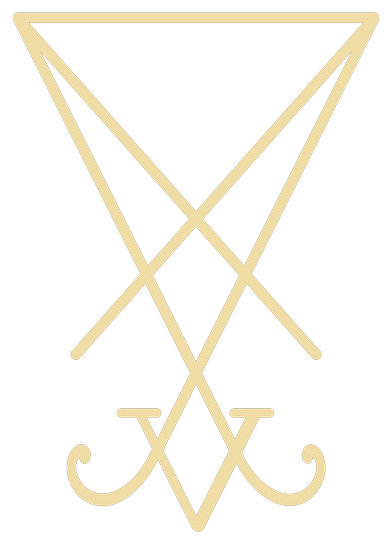
Our mark is not invented. It is the Seal of Lucifer, the seal of the light bearer from the grimoire Grimorium Verum (18th century), a sign the world has recognised for centuries. We took an old and genuine mark rather than drawing our own, because truth needs no new logo. Its exact meaning no scribe ever wrote down; the mages drew it as the seal of the one who carries the light. We read it like this:
- The chalice at the base, the vessel that catches the light: everything you are given, you must also know how to keep.
- The crossed paths in the centre, above and below meeting in a single point: Danica in the sky and Veles beneath the roots, joined by one hand.
- The point turned upward, the ascent: knowledge is not handed down from above as a gift, it is seized and climbed toward.
- The sign of the morning star, the last light before dawn, a name they turned into an accusation, and we into a banner.
Colours
Black, everything they cast into the dark, which then learned to see in the dark. Old gold, treasure, grain and wax: value that is earned, not inherited. Red we use sparingly, the way the old folk used red thread against the evil eye: for warnings, not for ornament.
Marks cut into stone
The same marks, but no longer a drawing on paper. This is how they look when someone cuts them into black slate and fills the cut with gold: no fog, no hedging, a single line that cannot be read two ways. Above stand the historical originals with their sources; here stands the same language in hard material.
A stone that turns
A mark is not a picture on paper. A mark is an object someone holds, carries with them and hands on. This one is cut in black stone, and the line inside it is gold poured into the cut. It turns slowly so you can see every face, because a mark is not read in a single glance.
The shared language of the dark
These are original signs, genuine, from the grimoires, alchemy and the old astronomy, not our inventions: the Seal of Lucifer, the Leviathan Cross, the inverted pentagram, the inverted cross, the star of Ištar. They have been redrawn by our own hand into a clean, hard line. Not one of them “summons” anything, each one remembers something. And beside each stands the thing that matters most: which reality of life it holds.
Every image in this set is an original historical source in the public domain, from grimoires, alchemy and the old astronomies, cast into our own gold. The stone plates above are our own renderings made after them. Take them, wear them, share them, only do not lie with them.
Sigils, the seals of the grimoires
A sigil is the oldest way to lock an intention into a drawing. Medieval sorcerers believed that every spirit had its own seal and could be summoned by it; we do not believe in summoning, but before the mastery of these lines we take off our hats. These are the original seals from The Key of Salomon (Ars Goetia) and the Grimorium Verum, just as hands copied them over the centuries. They summon nothing. They show everything: that a human being could turn even his greatest fear into geometry, catch it in a circle and so strip it of its power.
Seals from The Book of the Goetia of Solomon the King (ed. 1904) and the Grimorium Verum, public domain. They stand here as heritage, not as instruction.
What we do not use, and why
- The Sigil of Baphomet as that organisation uses it, together with its own name, is a protected mark of the Church of Satan, and that one we do not take as our own. The motif itself, a goat inscribed in an inverted pentagram, is older than they are: Stanislas de Guaita drew it in 1897, it is public domain, and we show it above, as we do Lévi’s drawing of Baphomet from 1856, which is a separate and older image.
- Anything that calls for violence. Whoever pastes our mark next to hatred has, by that very act, stripped it from himself.
IXLanguage is older than the church
A Balkan dictionary of the sacred
We never needed consecrated words out of foreign books. The people forged their own long ago, in the kitchen, in the field, at the funeral and at the table. Here we put them back on the altar: eighteen words that are our real liturgy, and that say more about us than any catechism.
“A word is not an ornament.
A word is a drawer: until you open it, you do not know what someone put inside.”The wall of drawers
There is a way to learn the truth about a people that they would never admit about themselves: look at which words they polished to perfection, and which they never needed at all. Language is the oldest archive we have, older than every church and every state in this region, and unlike them, an archive nobody managed to rewrite to their own measure. Written into it is what we feared, what we enjoyed, and what happened to us so often that we had to invent a shorthand for it.
Look also at where these words come from. Some are Slavic and older than all our names, others arrived with empires, through Turkish, Arabic, Persian, Greek, Latin, Hungarian, German, and then stayed because without them we felt cramped. That mixture is the only honest identity card this peninsula has. A man who talks about purity here is speaking a language that is its own best counterargument, and it is so in every second word he says.
So this dictionary is not folklore but foundation. We do not translate these words because they cannot be translated, and they cannot be translated because they do not describe things but states that nobody elsewhere ever had to name.
Inat
The refusal to be broken, even when giving way would be cheaper, smarter and warmer. The word arrived with Turkish, from an Arabic root meaning stubbornness and resistance, but here it acquired a weight it does not carry in the original. With us inat is not a trait but a last possession: what is left to a person after they take his land, his name, his job and his vote. That is why it is impossible to explain to anyone who has never belonged to somebody, and why every power tries first of all to cure it.
Misunderstood, inat brings down houses, marriages and states, and that is our famous inat that burns its own roof so the neighbour can watch the smoke. Understood correctly, it is the only reason we are still here. In Crni Hram inat is a defensive weapon: it is drawn against tyranny, never against a neighbour, and never, never against yourself.
In the temple, inat is the first root and the most dangerous. Strength with no direction always finds the nearest target, and the nearest one is usually you.
Merak
Deep, unhurried enjoyment of something small: the first coffee of the morning, evening light on a wall, a kind word at the right moment, a song that catches you and that you let run to the end. The word came through Turkish from Arabic, where it means both desire and rapture, but here it was ground into something more precise: merak is not excitement but attention. The same act, the same coffee, the same song, only without hurry and without a second thought in your head.
Merak is proof that holiness does not require a cathedral, a balcony and ten minutes of quiet will do. And that is why it is dangerous: a person who has merak is harder to buy, harder to sell the next thing to and harder to convince that something is missing from his life. It is no accident that they declared it laziness, then a sin, then finally a waste of time.
In the temple, merak is worship. It lasts ten minutes, it costs nothing and it is reported to nobody.
Ćeif
Merak’s stubborn brother. The thing is done the way you want it done, at your pace, in your order and with your hands, or it is not done at all. The word comes from the same world as merak, from Arabic through Turkish, where it means mood and ease, and here it grew a spine: ćeif is not merely comfort but the right to your own way. How the coffee is made, how the wood is stacked, how you sit and who you do not speak to before noon.
Ćeif is small, everyday sovereignty, and for that reason it is the most underrated notion in this dictionary. Empires came and went, borders moved five times in a single human lifetime, and ćeif remained unconquered because it cannot be entered in a land registry, taxed or banned. Power can take almost everything, but it cannot order a man in which sequence to do what he has to do anyway.
In the temple, ćeif is practice for bigger things. Whoever cannot defend how he drinks his coffee will not defend how he lives.
Sevdah
Sorrow that does not hide but sings. The sweet weight in the chest when you love, lose and remember, all at once and with no wish for it to stop. This word has the loveliest journey of any here: through Turkish sevda, love, back to Arabic sevda, which was the name for black bile, the humour by which old medicine explained melancholy. In one single word, then, love and blackness are joined, and that is not a poetic conceit but the literal history of the term. Our most beautiful word for love carries inside it the name for darkness, and nobody here has ever experienced that as a contradiction.
Other cultures treat sorrow with silence, with good manners or with a tablet. We made it into an art that is sung in company, out loud, at a table full of people, and nobody pretends he is unmoved. Sevdah is proof of the ninth root: you do not run from mortality, you compose from it.
In the temple, sevdah is our three hundred year old therapy. Feel it to the bottom, sing it out loud, then go on living.
Dert
Sevdah’s heavier brother. Dert is the grief you carry, the worry that does not pass by morning, the pain that has become part of the inventory. The word reached us from Persian through Turkish and means exactly that: pain, hardship, trouble. The distinction matters, because the people here were more precise than any modern psychology: sevdah is the weight that fills you and out of which a song is made, dert is the weight that empties you and about which nobody sings, only keeps quiet.
So dert is not said to be cured but to be told. There is someone to drink with, someone to say it to, somewhere to weep without explaining. A society that invented a word for this clearly knew it would be needed, and knew that unspoken grief kills people here more quietly and more often than any disease a doctor can name.
In the temple, dert is not carried alone. That is the only form of help we ask for and the only one we always give.
Obraz
Honour that shows on the face because it is literally worn on the face. The word is ours, Slavic, and the whole of an ethics is written into it: obraz is the face, the thing you look at a person with. That is why “to be left without obraz” is not a metaphor but a description of the punishment: to be left without a face, to look away, to cross to the other side of the street, to be unable to attend somebody’s wedding or funeral. And that is why the mask, which covers the face, is called obrazina in our language.
Obraz is not inherited, not bought and not returned at a sale. It is lost with one signature, one silence at the wrong moment, one person betrayed, and it is earned over years, mostly in small things nobody knows about. It is our only property deed: everything else can be taken from you, and this you can only lose by yourself.
In the temple, obraz replaces confession, penance and the fear of punishment. It works better than all three, because it does not forgive cheaply.
Prkos
Inat in work clothes. Prkos (defiance proved by doing) is when you get up at dawn and do well the thing they told you that you could not do, must not do, was not for you and that people like you had already tried. The word is Slavic and old, and unlike inat it has nothing of stubbornness for its own sake in it: prkos always leaves something behind, a house, a trade, a diploma, a child who was not afraid.
This is the purest form of prayer we recognize: proof by deed, against the prophets. You do not argue with those who said you could not, because argument is their ground. Do it, and let them watch. Prkos is also the only honest answer to everything that was written down as your limit here at birth.
In the temple, prkos is the only accepted form of proving yourself. The result speaks, you keep quiet.
Sabur
Patience that is not submission. The word is Arabic and means endurance, but here it settled in as the name for one very concrete skill: the ability to endure what cannot be hurried without turning bitter in the process. Illness, mourning, waiting, a year that has to pass, a person who has to come back on his own. Sabur is not the acceptance of injustice but the knowledge of when your hurry has stopped solving anything.
Our people knew that distinction better than we do: “have sabur” was never said to someone being trampled, but to someone who can change nothing and is wearing himself out. It is inat’s sister word. Inat gives you the strength not to kneel, sabur gives you the strength not to snap while you stand.
In the temple, sabur is discipline without a master. You wait because you decided to wait, not because somebody told you to keep quiet.
Hajduk
The archetype: the one who takes to the hills when authority becomes robbery with a stamp on it. The name reached us by a winding road, through Hungarian and Turkish, and along the way it meant cattle driver, soldier and outlaw, depending on who was holding the paperwork. That is the most honest possible origin for this word, because it shows exactly how the same person is filed in one office as a bandit and sung in one song as a hero.
The people sang about him because he said what everyone else kept quiet about, and they left out that the hajduk often robbed the very people he supposedly defended. We take the symbol, not the method, and we say so out loud: our hills are the public word, the court, a registered assembly, correct paperwork and our own table. Whoever praises the hajduk’s rifle today has usually never been in the hills or in trouble.
In the temple, the hajduk is a warning, not a model. A reminder of what happens to a society in which justice has no other address.
Jal
Our true national disease: pain at somebody else’s success. Jal is not ordinary envy, because envy at least wants what the other person has. Jal wants nothing for itself, it is satisfied if the other one loses. It is the only “supernatural” evil we recognize, because its effects can be measured: it destroys crops, marriages, companies and whole villages, and it does so without a single spell and a single curse.
The ninth prayer of Crni Hram runs: may it go well for me and for him. To say that sentence sincerely, inwardly, about a man you envied that same day is the ascetic feat of this region and harder than any fast. Whoever says it three times without lying has done more for himself than with an entire pilgrimage.
In the temple, jal is the only sin we recognize, because it is the only one that reliably harms both you and the other person.
Raja
Look at this word carefully, because the whole of this page stands inside it in miniature. Under imperial rule raja was the term for the subject, tax-paying class, and the word literally means a herd that is kept and milked. It was a label from above, cold, clerical, close to an insult. And then the best thing that can happen to a word happened: people picked it up and turned it around.
Today raja means our people. The crowd, the company, the ones you grew up with and with whom nothing has to be explained. The name they entered you under in a register became the name for warmth and belonging, without a single decree, purely by the force of daily use. Remember that procedure, because it is the same procedure by which we take the name Satanist: the name they branded you with, you wash and wear as your own, and from that moment it no longer serves them.
In the temple, raja is proof that any label can be taken over. Including the one we wear.
Sijelo
Community at its best: people gather in the evening, with no agenda and no occasion, and they work, talk and sing until they get to the real thing. The word is ours and transparent, from sjediti, to sit. It is that simple: sitting together was the sacred act. A sijelo once meant wool being spun, maize being husked and marriages being arranged, and along the way everything a village knew was passed on, because there was no other school.
Nobody presides, nobody charges, nobody preaches from a raised place. It is our answer to the church pew: a circle, not a column. The kolo round dance is the same theology, only faster, and in it lies the oldest proof of our equality, because in a kolo nobody stands ahead of anybody and everyone holds on to everyone else.
In the temple, the sijelo is the only rite we ask for regularly. Without it this is only text on a screen.
Sofra
The table you sit around until the main thing gets said, and the main thing is never said first. The word came through Turkish from Arabic, where it denotes a meal and the cloth spread out on the floor, and it carries the exact picture: a sofra is not furniture but an act. It is spread out, people sit around it, and while it lasts, rules apply that do not apply outside.
At the sofra one Balkan law older than inat holds: the guest is sacred, whoever he is and wherever he came from. Hospitality is our oldest ethics, formed before all the faiths that now quarrel here over the right to it, and it will outlive them all. Whoever insults a guest at the sofra has shamed the host; whoever insults the host at the sofra has thrown himself out.
In the temple, the sofra is the altar. The one place where we are required to keep quiet and hear the other person out to the end.
Komšiluk
The neighbourhood raised to the level of an institution. Komšiluk is not an address but an obligation that was never signed: they arrive first at a funeral, they know first when there is trouble, and they are first at the door when you need a hand, a ladder or silence. The word is Turkish, like half our courtyard, and it denotes something that for centuries here worked better than any state: a system of mutual aid with no paperwork, no premium and no payout date.
Komšiluk has its underside too, and it is only fair to name it: the same people who come first to save you also hold the sharpest opinion about how you live. The closeness that warms you is the same closeness that watches you. That is why this word stands right beside “what will the village say” in our dictionary, as its twin brother, and why we take the first part of it and refuse the second.
In the temple, komšiluk is the model of community: come when you are needed, do not judge when you are not.
Pobratimstvo
The family you choose, and binding at that. Here a person could take another as a sworn brother or sister, and that relation counted as blood kinship: you defended each other, helped each other, inherited from each other, and betraying a sworn brother was worse than betraying a relative, because a relative you did not choose. In the songs both the hero and the vila fairy are called pobratim, and that is not decoration but a serious legal picture of a world in which a bond can be created by a word and witnesses.
For us this may be the most important word in the whole dictionary. It proves that a people who today swear most loudly by blood never actually thought blood was the only criterion. Chosen kin is as old here as born kin, it only needed a name, and it got one long before anyone in the world started writing books about it.
In the temple, pobratimstvo is the only bond we recognize above kinship. That one you signed with your own name.
Zapis
The sacred tree of the village. One old oak, lime or walnut, marked and protected, under which people gathered, under which they prayed for rain and around which they walked in procession. It could not be felled or even pruned, and whoever did it would, by belief, be overtaken by misfortune. When the new faith arrived, the tree was not cut down but marked with its sign, and that is the best preserved example of how nothing here was ever erased, only layered over.
That is why the zapis stands in this dictionary. It is living proof that beneath everything that today looks like an order that has always existed, something older, more stubborn and calmer than it has gone on standing. Holiness here was never in a building. It was in a tree, in a stone, in a spring, and in who gathered around them.
In the temple, the zapis is our favourite proof: the old does not die, it gets a new coat of varnish and waits.
“Šta će selo reć”
The one omnipotent force of the Balkan pantheon, “what will the village say”. Invisible, omniscient, eternally dissatisfied and, unlike all the other gods, entirely free to maintain. To it were sacrificed marriages, careers, departures and returns, divorces that should have happened ten years earlier, loves that could not be admitted and children who wanted to be something else. It asks for neither candle nor fast, it asks only that you adjust in advance, before anybody says anything at all.
Its greatest strength is that nobody is its priest, while everyone believes the others are. Ask anyone in the village what he himself thinks and he will tell you he does not care, but that people will talk. Those people do not exist. Crni Hram is, technically speaking, atheism with regard to precisely this deity; everything else on this page is a footnote.
In the temple, this is the only god we explicitly deny. The others we merely do not worship.
Promaja
The only supernatural being the Balkans genuinely believe in, with no apostates, no schism and no reformation. Promaja, the draught between two open windows, mows down generations, causes everything from ear infections to a lifetime of neck stiffness, and no medical finding in the world has managed to shake that consensus. Grandmothers who agree on nothing else are as one on promaja.
We list it here with no ill intent and with genuine tenderness, as a memorial to two things. First, that even the hardest rationalism has to surrender somewhere, and that it is healthy to laugh at that, starting with yourself. Second, that a belief is most durable precisely when it is harmless, warm and inherited from somebody you loved. Take seriously only those beliefs that cost somebody something.
In the temple, promaja is our reminder to stay modest. We too close a window somewhere without evidence.
Not one of these words is anybody’s property. They all came with caravans, armies, merchants and songs, changed masters and stayed with us. Whoever counts them by origin instead of by meaning has missed both the dictionary and the peninsula.
XBeings out of the dark, truths out of the mirror
The pantheon of shadow
We do not believe any of these beings exists. We believe every one of them knows something. The people were not stupid: when they had no word for a fear, they carved a figure. Here are eighteen figures and the eighteen truths they keep.
“Not one face survived.
What survived is what people said to those faces.”A row of worn heads
Before you go down among them, understand how we read this, because whether the whole page makes sense depends on it. Myth is not a lie. Myth is the oldest database humanity has, assembled out of everything that happened often enough to have to be remembered, with no other way to write it down. An illiterate village could not produce a study of sleep paralysis, of an epidemic, of how a person behaves after losing a child, or of what a community looks like once it starts hunting for someone to blame. But it could carve a figure, give it a name and a habit, and pass it on by the fire. Every monster is a set of minutes.
So there is no summoning here, no protective rite, no instructions on what to do if something presses down on you at night. There are doctors for that, and this is not a joke but the only honest advice. Here there is something else: reading. Of every being we ask three things. What was actually said, whom that fear really kept in line, and what the being has to tell us today, now that monsters appear less often in the forest and more often in a contract, in a law and in somebody else’s sentence about what you ought to be.
And remember the rule that holds for all of them without exception: look at who profits from that fear. That question separates mythology from superstition and belief from obedience, and it is the only tool you actually need in this cellar.
Veles
Myth: god of cattle, of wealth, of the underworld, of magic, of the oath and of song; the serpent in the roots of the world tree; Perun’s eternal adversary in a duel that never ends but repeats every year. After the christening he was pushed downward, reassigned and renamed, and so became the Devil, while the more useful part of his work got a new uniform and stayed in the field.
Mirror: whatever power cannot tax it will sooner or later declare devilish. Your work, your pleasure, your knowledge, your body and your word. Keep them down in the root, where the thunder does not reach, and do not ask permission for them from anyone who first offers you protection from something he invented himself.
Vrag
Myth: the imported lord of evil who never quite settled in here. In our stories the vrag lives by the water and the mill, buys souls on paper, and regularly comes off as a fool: the peasant cheats him over the crop, the woman drives him off with a broom, the godfather outwits him at cards. And the word itself, take note, originally means enemy in the Slavic languages. Not a being but a role.
Mirror: the Devil is an empty slot in a sentence, into which whoever is currently in the way gets written. That is how the same man can be a neighbour one day and a pest the next. Nobody who truly believes he is ruled by someone dares to mock him; the people mocked their devil for centuries, and that is the best proof that power brought him to them rather than that they found him themselves.
Crnobog and Belobog
Myth: the black god and the white god, the shadow and the light of the world. An old chronicler wrote them down, and it is only fair to say the field still argues over how much of that is faithful tradition and how much is his own interpretation. But the image stayed and took hold, because it hit on something true: they were honoured together, because good without evil has neither shape nor measure.
Mirror: darkness is not evil. Darkness is one half. Whoever promises you a world without shadow is selling you the most expensive lie on the market, usually on a monthly instalment plan. A whole person knows both of his colours, apologizes for neither, and knows which one to let out in front when it is needed.
Morana
Myth: goddess of winter and death. Every spring the people carried her straw body out of the village with a song and then burned it or drowned it in the river, so that summer would be allowed to come. She was not driven out in hatred. She was driven out with respect, the way you see off someone who has done his part.
Mirror: nothing new begins until the old has burned all the way down: a relationship, a job, a conviction, the version of you that got you this far and goes no further. The people knew what therapy now charges for by the hour: an ending needs a rite, not an excuse. That is why everything that was not properly seen off keeps coming back for years, and always at the worst moment.
Suđenice
Myth: three women who come to a newborn in its first nights and pronounce its fate: how long it will live, what it will die of, what will happen to it. Bread, salt and a coin were left out for them, and care was taken that the child was not left alone that night. What they pronounce is pronounced, and it does not change.
Mirror: the belief that the verdict on you is spoken over the cradle while you sleep is the most accurate picture of what actually exists. You chose neither the language, the place, the surname, the property nor the faith you were entered under; all of it was pronounced before you could speak. But the suđenice said what would happen, never who you would be. That second part nobody pronounced for you, and it is the only space you have. This whole temple is built inside it.
Vila
Myth: the wild woman of the mountain and the water. She dances in the kolo on a clearing, heals wounds and inflicts them, takes heroes as sworn kin and helps them, and whoever tramples her dance ring or catches her at the spring comes off badly. She was not evil; she was untamed, and that was the whole difference.
Mirror: women’s freedom that asks no permission. The village called her dangerous exactly as often as it needed her to be, and it called her dangerous every time a woman refused the place assigned to her. Do not trample another’s dance ring: the body, the choice and the road of every woman are her own mountain, not a public good to be voted on at the table.
Zmaj
Myth: this one matters, because it demolishes everything you think you know about dragons. In our tradition the zmaj is not a monster that lays waste to the village but its defender. The local dragon guards his region, rises into the clouds and fights the storm powers that carry hail, and in the songs a hero born with that gift comes marked, with wolf hair or with small wings under his arm.
Mirror: notice where the people located salvation. Not above, in a sky that sends hail, but in a being that elsewhere was declared a monster, and that was born here, among us. When defence is needed, it comes from below and from within, with scales and a bad reputation. What they call your monster is sometimes the only thing standing between your field and the storm.
Ala
Myth: a storm being that drives black clouds and hail onto somebody else’s field, swallows the harvest, and, by belief, devours the sun and the moon during an eclipse. She was so hungry that our word for a glutton comes from her name: alav.
Mirror: greed described as a weather event, and it is the most accurate definition anyone has ever given. It does not arrive as a decision but as a front: it eats a year of work in one afternoon, does not distinguish whose field it is, and never has enough. Learn to recognize it on the horizon, because the ala rarely flies these days. Today it usually arrives with an offer, a contract and a deadline for signing.
Zduhač
Myth: a man whose spirit leaves him in sleep to defend his field against the storm powers and against other men’s zduhači, while his body lies as if dead and must not be woken. In the morning he comes back tired, scratched and silent, and does not talk about it. He was recognized by the fact that during the day he was entirely ordinary.
Mirror: a protector does not look like a hero. By day he is a tired man who does not talk about himself. The greatest battles for your household are fought where nobody applauds and where there is nobody to confirm you were there. Be somebody’s zduhač, and learn to recognize your own, because he certainly will not tell you.
Krsnik
Myth: in Istria and its hinterland, a man born with a white caul over his head, appointed to fight the one who comes back from the grave and the evil that comes upon the village. He fights in sleep and in animal form, usually as a light animal against a dark one, and it is a battle nobody watches.
Mirror: note where the people located the defence against evil: not in an institution, not in the authorities, not in heaven, but in one specific man from the house next door, who asked for nothing in return. Salvation here was always local and free. The next time somebody asks for money or obedience in order to protect you from an evil he described to you himself, remember that the krsnik worked for nothing.
Vampir
Myth: the dead man who comes back and drinks the living. The one word this region gave to every language in the world, exported from our villages after cases like that of Petar Blagojević in 1725, about which imperial officials wrote tidy official reports, with dates, witnesses and signatures.
Mirror: whatever you bury unresolved comes back and drinks. Guilt, debt, an injustice passed over in silence, a conversation put in the ground, it makes no difference. And second, more important: the whole of Europe then believed a panic that came with a stamp, a protocol and an expert opinion. Mass hysteria does not arrive in rags but in uniform. Learn to recognize both.
Vukodlak
Myth: a man who turns into a wolf. In the older layer of these lands the vukodlak and the vampir were one and the same being, and the wolf is merely the older skin: the name literally joins wolf and hair, and it covers everything that wakes in a person at night and is not admitted by day.
Mirror: the beast in you exists, and that is not an insult but an inventory. The only question is who holds the chain. Whoever denies his beast suddenly becomes it, and usually in front of the people who least deserve it. Whoever knows it, feeds it and leads it has strength without shame and a rage that knows the right address.
Mora
Myth: a night being that sits on a sleeper’s chest and allows neither breath nor movement: you see, you hear, you know where you are, and you cannot stir or cry out. She entered other languages too, and the English nightmare carries her inside it.
Mirror: with this figure the people described sleep paralysis exactly, centuries before neurology had a name for it. The lesson is double. First, fear always sits on the chest of the one who is lying down, and that is not a coincidence but a rule. Second, a myth is often a diagnosis that does not yet have a Latin name, so it should not be laughed at but translated.
Drekavac
Myth: a creature that shrieks at night by the streams and in the graveyards, and which by tradition is the soul of a child that died before the rite could be performed. It shrieks because it has no place either above or below, and it shrieks in the direction of the village.
Mirror: listen to what that myth actually admits: that there existed a doctrine prepared to leave even a newborn in the dark, for the sake of disciplining the living. Any system that sends the innocent into the dark in order to keep you in line has written its own verdict, and nothing needs adding. The drekavac is not shrieking at you. It is shrieking instead of you, and it has been doing so for a long time.
Baba Roga
Myth: the bogey of the nursery. “Be good or she will carry you off.” A relative of the great forest crone of the Slavic tales, the one who in the same story devours and bestows, depending on how she was approached and whether the child was polite and brave.
Mirror: the first lesson in obedience does not come from the church or the school but from the dark under the bed, and it comes from people who love you and mean well. Fear is trained while you are small, and afterwards it only changes its name to something larger and more official. Growing up is the act of switching on the light on Baba Roga and looking at what was actually standing in the corner.
Psoglav
Myth: a being with a dog’s head, a single eye and iron teeth, which lives in caves and abandoned mines and feeds on the dead. He was talked about everywhere across these hills, always with one and the same characteristic: he inhabits the place the storyteller has never been.
Mirror: this is what fear of the unknown looks like once it is given a face. Every culture in the world has its dog heads, and they always live beyond the line the story reached and the person did not. The danger of that myth is not in the cave but in the habit: the moment you describe somebody as something without a human face, everything you do to him afterwards goes down easier. It is the only monster on this list that genuinely killed people.
Karakondžula
Myth: a hideous night being that runs riot in the “unbaptized days” between Christmas and Epiphany, in the twelve nights that by the folk reckoning belong to no order at all. In those days you did not go far, you did not stay out, and you watched what you said.
Mirror: the calendar has a shadow too. A system that claims to cover everything admits a hole of twelve nights, and into that hole it puts a monster, so that nobody peeks in and sees that nothing frightening is happening there. We peek in precisely there. Wherever they tell you it is best not to look, that is where the view is clearest.
Bauk
Myth: a being that is never described. It lives in the dark, in a hole, in an abandoned house, and it waits. It has no face, no shape, no habits that could be listed, and that is exactly why of all the beings here it is the most frightening and the longest lived.
Mirror: the strongest power is the one nobody has seen: “it cannot be done”, “it is not allowed”, “everyone knows”, “this is not the time”, “it has always been this way”. A bauk rules exactly until you approach it with a lamp. Nine out of ten bauks are a chair with a coat thrown over it, and for the tenth you have reason, light and your own people, and that has always been enough.
Why we keep them in the temple at all
Because this is the most honest portrait of this region that exists. In it there is no hero without a flaw and no monster without a reason. The zmaj defends, the ala lays waste, the zduhač fights for nothing, the vila punishes whoever tramples her dance ring, the Devil comes off a fool, and the only genuinely dangerous being on the entire list is the one people gave a dog’s head so they could get past him more easily. Everything this peninsula knows about itself stands in those eighteen figures, and not one of them was written by a priest or a minister.
And so we repeat it one last time, because a text like this is easily misread: not one of these beings exists, nothing here is being summoned, and we recommend to nobody that they experiment with it. These are mirrors, and a mirror is useful for one reason only: sooner or later, the one you recognize in it is you.
XITheatre for a single spectator
Rituals as psychodrama
Not one of our rites summons anything or petitions anyone. Ritual is theatre played for exactly one spectator: your own nervous system. A candle, a fire and a given word do what an athlete’s routine before a match does, they gather scattered attention into one point and give a decision the weight a bare thought never has.
Why a rite at all, if there is nobody to receive it
The question is fair and it always comes first. If there is no god, no spirit, no power on the other side listening, then what is the candle for? The answer is simpler than it looks: the rite never actually worked upward. It worked inward. For thousands of years people lit, tied, spoke and broke things convinced they were negotiating with heaven, and the whole time they were changing the only thing that could actually be changed: themselves. That technology proved so good that it outlived every theology that served as its excuse.
We keep the technology and discard the excuse. That is the whole difference between us and magic. Magic claims the word changes the world outside your skin: that rain will fall, that a rival will fall ill, that money will come. We reject that claim for the same reason we reject hell, there is nothing to support it and it sells expensively. Our rite claims incomparably less and that is why we can defend it: an action properly performed changes the state of the person who performed it. Nothing more. But that “nothing more”, added up over years, is the only lever you actually have.
Picture two people who made the same decision. The first thought: from Monday I am changing my life. The second sat down at a table in front of four people, stood up, said out loud what she was changing and by when, touched glasses and sat down. No law of nature moved for either of them. But the second one has something the next morning that the first does not: a moment with a sharp edge, witnesses, and shame working for her instead of against her. The Balkans have known this for centuries and call it a given word. Psychology later called it commitment before witnesses and wrote books about it. The same thing, two addresses.
The six levers of every rite
Strip everything supernatural off a rite and six parts remain. Each of them does something measurable, and every ritual of ours below is assembled out of them. Learn these levers and you will be able to build a rite for anything yourself, instead of looking for it in someone else’s book.
- The boundary. An exact time and an exact place. A rite performed “whenever I get around to it, somewhere” is not a rite but an intention, and intentions die on a Tuesday. The boundary tells the body: it is different now than it was a minute ago.
- An act of the hands. Something has to physically happen: lighting, tying, pouring, writing, burying. A thought is slippery, a hand is not. What the hands did, memory holds differently from what the head merely thought.
- The word out loud. Spoken in the first person and the present tense. Not “I should”, but “I am doing this, and by such and such a date”. Your own voice is the only voice with authority in this temple, and the only one you cannot later pretend you did not hear.
- A witness. People at the table, a fire in front of you, an empty chair, a page in a notebook. The witness does not have to be alive, it has to be outside you. What has left you is harder to take back than what stayed inside.
- A trace. A thread on the wrist, ash in the ground, a dated line. The trace is a message you send yourself for three weeks from now, when the fervour has gone and the obligation has not. Every glance at the wrist repeats the decision for you, free and without a sermon.
- An ending. A clear close: put it out, stand up, shut the notebook, walk out. A rite with no ending spills into the day and is worth nothing. The brain releases badly what has no closing act, which is why funerals exist, and why here there is always a last move.
Rites for every day
These need no date. They need repetition, and that is their whole secret: a rite performed once is an event, a rite performed three hundred times is a character.
Black coffee
- Every day
- 10 minutes
- Coffee or tea
- Make the coffee slowly, the way it is properly made, not the way you can fit in. The making itself is part of the rite; speed is the only sin here.
- Sit alone. Phone in the other room, it has its own gods and its own rites and it does not need you for them.
- While you drink it, do only that. First sip: what I have to do today. Second: what I want to do today. Keep the two apart to the bottom of the cup, honestly, without decoration.
- The last sip is the end. Get up and go to work, no extension and no delay. The cup is washed straight away, that is how the boundary closes.
Why it works, ten minutes of undivided attention a day trains the same muscle you later use to resist fear, advertising and someone else’s tempo. In this region the coffee cup is older than every church that found it here; we are only putting it back into service. Whoever cannot stand ten minutes alone with himself already knows why this rite is first on the list.
The watch before dawn
- When clarity is needed
- Half an hour
- A window facing east
- Get up before dawn, at the hour when Danica, the star the world calls Lucifer, is visible above the horizon. If it is cloudy, never mind; she is there, and so are you.
- Do not switch on a light, do not open a screen, do not check anything. Stand or sit by the window and watch the sky change, without a single word.
- When the first light appears, say out loud one thing you are carrying today and one thing you are leaving behind. Two sentences, no more.
- Go back to bed or into the day, it does not matter. The rite is over the moment you have spoken.
Why it works, it is the one hour of the day nobody demands from you: not work, not family, not the network. Time seized out of somebody else’s schedule shifts the balance of power in your head more than any slogan ever spoken. And one more thing, the last light before the sun literally bears the name they frightened you with. To stand before it calmly, without fear and without worship, is our entire teaching compressed into half an hour.
The toast
- As needed
- Before witnesses
- A glass of anything
- Stand up at the table when you are deciding something important: a job, a departure, a return, a beginning, an ending.
- Say it out loud, in the first person and the present tense: what you are doing and by when. No “I will try” and no “God willing”, responsibility is not shared with anyone here.
- Touch glasses, drink, sit down. From that moment the word no longer belongs to you but to the table.
- If you do not keep it, you come back to the same table and say so out loud. That is the second half of the rite and it is harder than the first.
Why it works, an intention spoken in public puts the strongest force in this region, obraz (honour, the face you keep before others), to work as an engine instead of a burden. Psychology calls it commitment before witnesses and measures how much it raises the odds of follow-through; the sofra puts it more briefly: you said it, we heard it. That is why there is a fourth step. A toast without a return to the same table is only a pleasant evening.
Sijelo
- Once a month
- 3 to 13 people
- One candle
- Gather in the evening, at a table, around one candle. Phones in a box by the door, that is their sijelo.
- The circle has two rules: everyone speaks once before anyone speaks twice, and nobody solves another person’s problem until asked. Uninvited advice is the cheapest form of power.
- Whoever has nothing to say, says that too. Silence is a full contribution, but it has to be spoken, not performed.
- Finish with a song or a toast. Whoever carries the heaviest load chooses the song; it is the only privilege handed out here.
Why it works, a circle without a chairman is the oldest Balkan democracy and still the best one. An hour of real listening a month holds a person together better than a confessional: nobody imposes a penance, nobody absolves you, and everybody heard. What has been heard is no longer only yours, and that is exactly why it becomes lighter to carry.
The zduhač watch
- Once a month
- A quiet deed
- No witnesses
- Do something concrete for someone in your own “field”, family, neighbourhood, trade, in such a way that nobody learns who it came from.
- Tell nobody. Not them, not your own people, not the network. Published goodness is advertising; this is a watch, and a watch is not announced.
- Let it be something that genuinely costs you: time, money, effort, your place in somebody else’s queue. Goodness that costs nothing proves nothing.
- Keep a quiet list in the notebook from the unbaptized nights, only a date and one word. It is the only statistic of your worth we recognize.
Why it works, a good deed without an audience is the only one that proves anything to you yourself, and you are the one judge who cannot be bribed. By tradition the zduhač defends his field while the body sleeps and nobody is watching; it is the most honest image of responsibility this people ever carved. Our answer to charity given to the sound of a band and to goodness that gets announced before it happens.
Putting out the jal
- When it stings
- 15 minutes
- Paper and pencil
- When somebody else’s success hurts you, and it will, do not run from it and do not fake joy. Sit down and write the name, and under it exactly what that person has that you would want.
- Below that, write one sentence: what you would have to do to have it. If the answer is “nothing, it cannot be done”, write that too, honestly.
- Say out loud the old sentence of this temple: may it go well for him and for me. The first time it will sound false. Say it anyway.
- Burn or tear up the paper with the name, and copy the sentence about what you have to do into your notebook. The name goes to ash, the task remains.
Why it works, jal (pain at another’s success) is the one evil that genuinely destroys crops, marriages and companies on this peninsula, and the only supernatural thing we are prepared to believe in once we see the consequences. It works by turning somebody else’s gain into your loss, although nobody took anything. This rite splits that account back into two: what is theirs stays theirs, what is yours becomes a list of jobs. Envy converted into a task stops being poison and becomes fuel.
Rites of the wheel of the year
These have dates, and that is not an accident. A year without markers runs like water and in the end nothing is remembered; a year with rites has a spine. The dates below rest on the folk customs of this region, explained in the next section, and not one of them binds you if that day does not suit you. The calendar is a servant, not a master.
Veles’s night
- 11 and 12 February
- The yearly oath
- Woollen thread
- Give that night one hour of silence. Go over the year behind you as honestly as if it were somebody else’s: where did you kneel, and where did you stand?
- Write one, only one, oath for the year ahead. Small, measurable, your own. The kind you can answer with yes or no in twelve months, with no discussion.
- Tie a woollen thread around your wrist, Veles’s fibre; against the evil eye the old folk tie a red one, so take whichever you like, the colour changes nothing here.
- Wear it until the oath is fulfilled. When you fulfil it, the thread is cut and burned, and only then may the oath be talked about.
Why it works, the thread is a reminder on the skin, and skin does not forget the way a calendar in a phone does: every glance at the wrist repeats the decision for you. One oath holds precisely because it is one; ten New Year resolutions die by February, and we are only starting in February. This is the night when the blago is counted, and the oldest wealth an ordinary man ever had was his word.
The burning of Morana
- 20 and 21 March
- The spring equinox
- Paper and a safe fire
- Write on paper what has to leave with the winter: a habit, a fear, a name, a debt, a role, whatever has kept you under the ice.
- Outside, safely, in a vessel or on a hearth, burn that paper the way the people burn the straw Morana. Watch until it has burned all the way down; do not look away and do not poke at the fire.
- Bury the ash in the ground or give it to running water. Wash your hands. The ending has to be physical.
- Do not talk about it for a week. A decision that gets told is spent in the telling.
Why it works, the brain releases badly what has no closing act; that is why funerals exist, and why people drag along for years relationships that ended long ago. This is a funeral for what has to die in you so that you can live. The custom is older than any explanation we can give it, and we give it back its purpose: winter is not a season but a state, and it does not leave on its own.
The midsummer fire
- 21 to 24 June
- The summer solstice
- Company and a bonfire
- Gather your people around a fire: lawful, registered where it has to be, far from anything dry and with water at hand. This is a celebration, not an item in the crime pages.
- Everyone says out loud one thing they did that year which they had been told they could not do. The fire is the witness, the others are a jury permitted only to raise a glass.
- Whoever has nothing to say listens and pours. That is a role too, and there is no shame in it; for somebody every year is only survival.
- Sing. Loudly and badly. The peak of the light is not analysed, it is spent.
Why it works, a shared fire and a shared voice are the oldest technology of belonging we have, older than all the parishes that now announce those same bonfires. That is how a tribe remembers it is a tribe, with no priest anywhere near and no enemy in the story. Leave the jumping over the fire to the young, to the insurers and to their own consciences.
The wolf vow
- mid November
- The wolf days
- One “no”
- On the wolf days, when by the folk calendar the beast is respected and not provoked, sit down and write a list of what you go along with all year and should not.
- Circle one item. Only one, the one that eats at you most and is not impossible.
- By the end of the week say that “no” out loud, to the person it belongs to. Calmly, briefly, with no explaining and no apology longer than one sentence. You do not explain to a wolf, a wolf shows itself.
- Write down the date and the consequence, whatever it turns out to be. What collapsed and what did not are equally data.
Why it works, a boundary that is never spoken exists for nobody except you, and then you are the only one paying for it. In the folk calendar the wolf days are days of caution before the beast; we read them the other way round: once a year the beast is you, and exactly as much as it takes for you not to be eaten. One well placed “no” holds for a whole year; ten angry arguments do not hold for a week.
The empty place
- 1 and 2 November
- Days of the dead
- A chair and a plate
- Set one extra place at the table: a plate, a glass, a chair. No candle in a church, no prayer, not one word about what comes after, because about that we know nothing.
- Cook what that person loved. If you do not know, cook what you think they would have loved; even a mistake is a form of remembering.
- At the table everyone says one thing they learned from that person. Not praise and not a eulogy, but one concrete thing they do today because that person existed.
- At the end the place is cleared like any other. No leaving food out overnight and no talking to the empty chair; there is nobody there, and that is the whole point.
Why it works, people on this peninsula visit graves and light candles because they understood long ago what is now repeated to us from lecterns: mourning needs a shape, otherwise it spills across the whole year. We take the shape and leave out the blackmail of eternity. The dead get no benefit from our candle, but the living get the benefit of one evening in which they are allowed to remember out loud, and after which the table is cleared.
The unbaptized nights
- 25 December to 6 January
- Inventory of the shadow
- A notebook
- Twelve nights that by the old reckoning belong to nobody, used as the only honest annual report you will ever write: to yourself, with no auditor.
- One question each night, written by hand: What did I do this year out of fear? What out of will? Whom do I owe an apology, and who owes me one? Where did I lie to myself? What have I postponed for the third time running? Whom did I fail by staying silent?
- Do not read back until you reach the twelfth night. Correcting as you go is decoration, and this is not a letter for the public.
- On the twelfth night read it all at once. Burn one page the way Morana is burned, copy one into the oath for Veles’s night. Keep the rest; a year from now it will be the most valuable book in the house.
Why it works, in the hole in the calendar, when by tradition the karakondžule are abroad and the year hangs between two numbers, a person tells himself the truth most easily, because nobody is measuring him. Writing by hand slows thought enough that you cannot skip over it, and research on expressive writing shows that simply naming what is hard changes how heavily it presses on you. No confessional offers this: no penance, no absolution, and nobody else knows.
How to build your own rite
Nothing listed above is sacred and nothing is compulsory. If you need a rite for something that is not on the list, for a move, for a parting, for a first day in a new job, for a reconciliation, build it yourself. The procedure is always the same and takes five minutes:
- Decide what exactly the rite does. One sentence, no fog. “I am letting this job go” is a rite. “May things get better for me” is nothing.
- Set the boundary: when and where. Let the date have something to do with the matter itself rather than with your schedule, if at all possible.
- Find an act of the hands that is a picture of that sentence. Letting go? Then something goes into fire, water or earth. Beginning? Then something is lit, tied or used for the first time.
- Write the word you will say out loud. Ten to thirty words, first person, present tense, no conditions and no “if”.
- Choose a witness and a trace: who watches and what is left tomorrow.
- Set the ending before you begin. A rite with no ending agreed in advance turns into a mood, and a mood is not a tool.
Run it past the three rules in the red box above. If the rite passes, it is yours, and it is worth exactly as much as any rite a thousand years older. Every one of those was once somebody’s good idea on a Tuesday evening.
When a rite becomes a sickness
We write this because it costs us honestly, and so does everything else on this page. The same mechanism that makes a rite useful can turn it into a cage, and that line needs to be recognized in time. Your rite has gone wrong if any of the following appears:
- Fear of skipping it. If you believe something bad will happen because you did not light the candle, you no longer govern the rite, it governs you. Our rites have no power at all, so they have none when you skip them either.
- Counting and repeating. If the act has to be performed an exact number of times, and repeated because “it did not come out right”, that is no longer a rite but a compulsion, and it is discussed with a professional, not with a temple.
- A substitute for treatment. No rite cures an illness, replaces a medicine, a therapy or a doctor, and whoever tells you otherwise is lying to your face. Fire is for paper. For everything else there are people who spent years learning it.
- Somebody is charging. The moment anybody asks you for money for a rite, a cleansing, the lifting of a curse or some special knowledge, you are looking at trade in fear, and the oldest kind at that. Everything written here is free and public, and that is not generosity but a condition of existing.
- Separation from people. A rite that moves you away from family and friends is working against itself. Our liturgy is a table, and a table does not set itself.
- Serious trouble. If something big is tormenting you, if everything has gone black in front of you, if you are thinking of harming yourself, a rite is not where you go. Go to a doctor, call emergency services, call a helpline, wake up someone close to you. We say this with no qualification and no mystification: in that situation no candle, no thread and no vow is your friend. People are.
And what if I feel nothing?
Then you have just received the most honest possible proof that we are selling you nothing. A rite is not a machine for feelings and it does not have to shake you in order to work. Most of them act like sandpaper, not like lightning: you notice nothing until one day you realize your hand no longer shakes in front of things it used to shake in front of. If it still does nothing, not even slowly, drop it without a twinge of conscience. There is no sin of omission here, no penance and nobody keeping records.
And remember the most important thing, the reason this section is on the page at all: a rite is not a substitute for the deed. A toast does not write the job application, a thread does not learn the trade, a fire does not repay the debt, and a candle has never washed anybody’s obraz. All of that is still done by you, in the morning, tired, with no audience. The rite is only the moment in which you told yourself clearly what you are going to do. The rest is work, and it is the only part that actually counts.
XIIThe wheel of the year
The calendar of Crni Hram
Honestly, right away, before the first date: this calendar was assembled, not excavated. We put the schedule together, here and now, but not one day in it was invented out of nothing. Every one rests on a real folk custom, on a layer of old timekeeping, or on a saint’s day beneath which an older outline shows through. We claim nothing about how our ancestors celebrated; we claim only what we do and why we do it then.
“Before every calendar, someone counted at night.
The sky was the first law, and the only one that never lied.”The sky over the karst
Why a calendar at all
Because time is the only property we all receive in the same quantity and the only one we lose without an invoice. A year with no markers runs like water through the fingers: it passes, and at the end nothing is remembered except that it was exhausting. A year with rites has a spine. You know where you stopped, you know what you promised in February, and you know that in December comes the night when it is read out loud. No religion ever survived because it had better arguments than the others. The ones that survived gave people a rhythm.
So we take that tool, as we take the rite and the symbol, and we clean off the thing that makes us keep an eye on it in the first place. In our calendar there are no holy days of obligation, no sin of omission, no fast supervised by a neighbour and nobody keeping a record of your piety. There are only six to thirteen points in the year at which a person stops, looks back and says out loud where he is.
Two halves of the year
The old folk calendar of this region was not divided into four seasons but into two great halves, the summer one and the winter one, and their borders are two days every shepherd and every ploughman knows by heart. Jurjevo, Saint George’s day, opens the summer half: the cattle go out to pasture, greenery is brought into the house, the contracts for day labourers and herdsmen start running. Mitrovdan, Saint Demetrius’s day, or Martinje in the western layer, closes it: the cattle come back into the stable, the accounts are added up, the young men come home. Everything in between is worked; everything after it is counted.
That division is not our invention but one of the best documented layers of the local folk calendar, and we keep it as the frame of the whole year. In summer you build, in winter you settle accounts. That is why our rites of oath and inventory are packed into the winter half, and the rites of community and fire into the summer one. It is not mysticism but a work schedule, as old as the work itself.
| When | Night / days | What is marked | Practice |
|---|---|---|---|
| 11 and 12 February | Veles’s night | The night of the old god in the depth of winter, when the cattle are in the stable and the blago is counted. The date is not accidental: 11 February is, by the eastern reckoning, the day of Saint Blaise, patron of herds, and it was precisely onto that saint that Veles’s old duties fell in popular piety. The name changed, the job stayed the same. | An hour of silence, a review of the year gone by, one single oath for the next one, a woollen thread on the wrist. |
| 1 March | White and red (regional) | In the eastern part of the peninsula a twisted white and red thread is tied on the first of March and worn until the first swallow or the first tree in blossom is seen. One of the most stubborn pre-Christian customs no power ever managed to ban or to re-dress. | For those to whom that custom belongs at home: the thread is tied the same way as Veles’s, as a visible deadline on a promise. |
| 20 and 21 March | Morana (spring equinox) | The death of winter. The people burn a straw doll or throw it into the water so that spring may enter the village. The rite survived almost intact across the northern Slavic lands, and this region carries its trace as well. | The burning of Morana: onto paper what has to go, then into a safe fire, then the ash into earth or water. |
| 23 April (6 May by the eastern reckoning) | Jurjevo (Green George) | The opening of the summer half of the year. Processions with greenery, the first driving of cattle to pasture, washing in the dew, songs recorded across the whole peninsula. One of the oldest recorded ritual layers we have. | The day of beginning: what you have been putting off for months is begun today, even if only with a first five minute move. No preparation, no conditions. |
| the night before 1 May | Filipovčica | A night on which the people believed witches gathered, so fires were lit and noise was made to drive off evil. We remember it the other way round: it is the night on which you can see most clearly how an enemy is manufactured, because the “witches” were as a rule old women who knew herbs, women without a husband, and anyone the village found inconvenient. | A night of remembrance for the accused: read something about the witch hunts, then say out loud one name that was unjustly blackened in your own region. |
| 21 to 24 June | Ivanje (Kupalo) | The peak of the light and the shortest night. Bonfires on the hills, wreaths, herbs gathered on precisely those days. A custom older than all the parishes that announce it today, and one of the few that survived untouched because it was too big to ban. | The midsummer fire: a bonfire, company, one victory said out loud, a song sung out of tune. |
| 2 August | Day of thunder (Saint Elijah’s day) | The day the thunderer got a new name and stayed in service: the fiery chariot, the lightning, the hills dedicated to the same figure as before. Our memorial to the mechanism that explains this whole page: gods are not killed, gods are re-dressed. | A day of caution toward every power that presents itself as eternal and natural. Read something from the library; thunder favours the ignorant. |
| 21 to 23 September | The scales (autumn equinox) | Day and night of equal length, the one natural balance in the year. The harvest is in, it is known how much came out. We acknowledge this date as ours, assembled without leaning on any single custom, because a year needs a point at which it is measured. | The half-year reckoning: read the oath from Veles’s night. If you are standing, keep going; if you are not, correct course out loud and in front of somebody. |
| 1 and 2 November | Days of the dead (zadušnice) | The time when the whole peninsula, regardless of faith and script, goes out to the graveyards. Beneath all today’s forms lies a far older layer: food, drink and a place left for those who are gone. | The empty place: one extra plate at the table, one concrete thing learned from the dead said out loud, and then the table is cleared. |
| 8 November (with Martinje, 11 November) | Mitrovdan | The closing of the summer half of the year: cattle into the stable, accounts on the table, contracts broken off or renewed. The second pillar of the folk calendar, the pair to Jurjevo. | A day of clearing up: pay what you owe, collect what is owed to you, and close one piece of business you have been dragging along for months. |
| mid November | Mratinci (the wolf days) | The days of the wolf in the folk calendar: the time when the beast is respected, named carefully and not provoked, and in some regions may not be named at all on those days. | The wolf vow: a week of boundaries. Say the one “no” you have been putting off all year. You do not explain to a wolf, a wolf shows itself. |
| 21 to 22 December | The long night (winter solstice) | The longest night and the turning of the light. Around that time stand the burning badnjak log, the singing processions from house to house and every custom for calling the sun back. The best preserved pre-Christian layer of the whole year, and in plain sight of everyone. | A night of enduring: let it be dark and do not fix your mood with anything. Light one fire or one candle and sit beside it until it burns out. |
| 25 December to 6 January | The unbaptized nights | Twelve nights outside the order of things, when by tradition the karakondžule run riot, when nobody works at night, washes clothes or travels alone. A hole in the calendar no system managed to patch, because it needed the hole too. | Inventory of the shadow: twelve questions, twelve pages, written by hand, read only on the last night. |
What is recorded, and what we put together ourselves
This is the only list of its kind you will find on a page like this, and it stands here deliberately. Whoever does not distinguish a source from his own idea sooner or later starts selling the second as the first, and we built this whole page on keeping the seam visible.
- Well documented among the people: Jurjevo and Mitrovdan as the borders of the year, the midsummer bonfires, the badnjak and the solstice processions, the unbaptized nights and the karakondžule, the wolf days in November, the days of the dead, the white and red thread on the first of March, the beliefs about the night before the first of May.
- Documented, but outside our region or only in traces: the burning and drowning of Morana, best preserved among the northern Slavs, and here only glimpsed in spring processions and dolls.
- A layer that is reconstructed, not read: Veles’s place beneath Saint Blaise and Perun’s beneath Saint Elijah. Those are the conclusions of philologists and ethnologists drawn from comparing names, places and songs, not preserved documents. Very persuasive, but conclusions.
- Ours, assembled here and now: the schedule of this calendar itself, the date of 11 and 12 February as Veles’s night in the form we use it, the autumn scales, and all the practices in the right hand column of the table. No shepherd ever did an inventory of the shadow in a notebook. That we added, out of what we know about how a person actually works.
How this calendar is used
As a schedule, not as a law. Five rules, and all of them short.
- A missed day is not a sin. If 21 March is a working day from hell, Morana burns on Saturday. Heaven will not notice, because there is nobody up there to notice.
- Better little and real. Three rites a year that you actually perform are worth more than thirteen you read about and nodded at. Start with Veles’s night and the unbaptized nights, that is the skeleton, the rest is flesh.
- Nobody pushes into another person’s house. If your people at the table celebrate Christmas, a slava or Bajram, you sit down with them like a decent person. Our calendar has not one point that asks you to insult anyone or spoil anyone’s holiday; whoever draws that out of it drew it out of himself.
- The date serves the matter, not the reverse. If your life is breaking in August, you do not wait for February to say so. The calendar exists for the days when nothing is on fire, because those are exactly the days when the most gets missed.
- Nothing is counted out loud in front of others. No records, no reports, no questions like “did you light it this year”. Whoever starts asking that has broken more rules of this temple at once than the person who lit nothing.
A note that applies to this whole section: whoever celebrates Christmas, a slava, Bajram, Hanukkah or none of the above is a free person, and our calendar takes nothing from him and disputes nothing. The wheel of the year turns for everyone, equally long and equally indifferent; we only choose where in it to stop and say out loud where we are.
XIIIAsk, that is what we want
Questions and answers
Every question you are going to ask has already been asked, usually with a reproachful shake of the head and a “come on, we know what that is”. Here are the answers, with no hedging, no secret levels and no sentence that gets explained differently later. If a question is missing here, that is an oversight, not a defence.
“No question is rude.
What is rude is an answer that fears being checked.”The chair of the one who asks
Read this list as a cross-examination. That is how it was written: every question was put as harshly as we knew how, including the ones we are not comfortable answering. A system that answers its most uncomfortable questions with fog, smoke or wounded feelings has already answered you.
On what we believe, and what we do not
Do you believe in Satan?
No. We do not believe Satan exists, not as a being, not as a force, not even “a little, just in case”. The same goes for demons, angels, spirits, curses and everything that is supposed to exist outside the world that can be checked. We have no secret teaching in which it turns out to exist after all; this is the whole teaching and it is written on a public page.
That is not our eccentricity but the rule of the entire modern tradition. Serious Satanic movements in the world have been non-theistic from day one: the figure of the rebel is used as a symbol, as a mirror and as a literary character, never as a deity to be prayed to. Whoever is looking for devil worshippers will find them in two kinds of source, in horror films and in police panics that later fall apart in court.
Our difference from our Western relatives is that our symbol did not have to be imported. The Balkans have their own devil with a history, a god who was declared a devil, and with the paperwork to prove it. Hence Veles, not Satan. The name the world understands stands at the door; the name that grew here out of the soil stands inside.
Is Lucifer the same as Satan? And why do you claim he is good?
Historically they are not the same, and this is not pedantry but the heart of the matter. Satan is the Hebrew word for adversary or accuser: a function in a court, not a name on a baptismal certificate. Lucifer is the Latin name of the morning star, Venus before dawn, the very one our people called Danica and by which they knew when to get up. They were fused only by later translators and commentators, who read a taunt aimed at one ancient king as a description of an angel’s fall. That is how a star acquired a court file for somebody else’s deed.
When we say Lucifer is good, we are not canonizing a being, because there is no being. We are saying that what the figure carries, light, knowledge, dawn, walking upright and the refusal to crawl, is good, and that history confirms it every time some “forbidden knowledge” turns out in time to be a printing press, a vaccine, a school for everyone or the right to vote. The evil they frightened you with under that name, looked at closely, almost always turns out to be somebody’s fear of your independence.
Remember the mechanism too, because it repeats: first they take your name, then they try you under it. The same thing happened to the morning star in the West and to the god of wealth and song here. Two sides of the same procedure, and that is why this temple has two wings.
All right, so do you believe in Veles then?
Not as a being. To us Veles is an archetype: a compressed account of what happens to the work, the pleasure, the knowledge and the word of an ordinary man when the government changes. Nobody here lights a candle to Veles, prays to him or expects anything from him. That would only be a new kind of kneeling with a more exotic name, and kneeling is against our statute regardless of who it is done in front of.
The difference between an archetype and a deity is practical, not philosophical. From a deity you ask for something and in return you owe something. An archetype can give you nothing and asks for nothing; it is the shape in which a people stored a conclusion reached over centuries of watching. When we say Veles, we say: whatever power cannot tax, it will declare devilish. That is a claim about people and power, not about the supernatural, and it can be checked in any century.
Among us there are atheists, agnostics, people who love the rite as art and people interested only in the ethics. They have one thing in common: nobody claims to know what cannot be known, and nobody charges for somebody else’s fear.
Then why use the word “Satanism” at all? Is it not just marketing?
Partly it is, and we will not pretend otherwise. That word stops a person mid-scroll, and no milder one would. But if that is all you see in it, you have missed the more important part.
For centuries “Satanist” was not anybody’s choice but a label the authorities pasted on others, usually just before taking their property, their freedom or their life: on old women with herbs, on heretics, on scientists, on dancers, on foreigners, on anyone who stood out. Taking that label into your own hands is the one move that strips it of its power for good. An insult you wear yourself is no longer a weapon in somebody else’s hand; it becomes a coat of arms.
Besides, the word is accurate. We genuinely are an adversary, and that is our job: an adversary to every system that lives off your fear, your ignorance and your submission. If we called ourselves something softer, we would have to explain what we are. This way we explain what we are not, which is a shorter conversation and an honester start.
Do you believe in fate, karma, energies, horoscopes?
No, and we are consistent about it all the way, which is more than can be said for many who laugh at us. There is no sense in discarding hell and then believing the Moon ruined your week. If something claims to act on the world, it has to be checkable; if it cannot be checked, then it says nothing about the world, however lovely it sounds.
That does not mean those things are worthless as a language. A horoscope is often just a polite way for a person to talk to somebody about himself, and “bad energy” in a room usually means two people are in a quarrel and everyone can feel it. We accept the content and reject the explanation. The difference matters the moment somebody starts making decisions about medicine, marriage or money on the basis of the stars.
The only “supernatural” force we recognize is jal, and only because we can see its consequences in crops, marriages and companies. On promaja, we admit, the debate is ongoing.
What do you think about death? Is there anything afterwards?
We do not know, and we will not pretend that we do. All we have on the subject is guesswork, and guesswork sold as knowledge is the oldest business in the world. What we can say is this: we have not one reason to believe that anything of you continues to exist, and we have very good reasons to think it does not. We behave accordingly.
So there is no paradise and no hell here, no reward and no blackmail. That is not coldness but the opposite: when nobody promises you a second chance, this one becomes the only one and thereby incomparably more expensive. Death is not a punishment but a reason to postpone nothing, to make peace while there is still someone to make it with, and to say today what you meant to say “one day”.
Sevdah is our science of death and it is better than most theologies: the art of feeling grief to the bottom and making a song out of it, instead of burying it so that it poisons you. Whoever has settled his accounts with death can no longer be ruled. That is why they tell you not to think about it.
On organization, money and power
Is this a sect?
Check it against the list, because that is how every sect is recognized, including the ones with large buildings in the city centre and the one that could one day grow out of this:
A guru whose word may not be questioned? We have none. A membership fee, a tithe, “voluntary” contributions with a record of who gave how much? None. Secret teachings you receive only once you are in deep enough? Everything is on this page, down to the last line. Separation from family and “unbelieving” friends? The opposite, the sofra is sacred to us. Punishment, blackmail or shaming for leaving? The door is open both ways and nobody will call after you. A date for the end of the world or salvation for the chosen? Neither; our calendar is a circle, not a countdown.
If any of those things ever becomes true of us, apply the first rule from the “Who we are” section: get up and go, and say so out loud. A movement that cannot bear being publicly left has already become the thing you are afraid of.
Do you have a leader, priests, a hierarchy? Who writes this anyway?
There is no leader and there will not be one. No priests, no degrees, no titles earned through time or obedience, nobody who could expel anybody, because there is no list to strike a name from. This is written by a handful of people from this peninsula who got tired of choosing between kneeling and emptiness, and their names are neither important nor secret; what matters is that no line of theirs is worth more than your objection to it.
If somebody ever turns up speaking of himself as the voice of Crni Hram, interpreting what the “correct” teaching is, or demanding obedience in the name of these texts, that person is lying, however well he knows these pages. The teaching is here, public and free; there is no intermediary because there is nothing to mediate.
The only hierarchy we recognize is the one earned again every day: whoever knows more about something has a stronger word on that subject, until somebody arrives who knows more still. That is not a rank, it is a condition that lasts until the next argument.
Who pays for this? Where is the money?
Nowhere, and that is deliberate. No account, no donations, no subscription, no members-only part of the site, no course, no seminar, no sale of amulets, candles, classes in “authentic Slavic magic” or anything else. The site costs what the domain costs plus a few nights of somebody’s free time, and that is the entire budget.
The reason is not modesty but caution. Money is the fastest known way for a movement to acquire power over people, because as soon as there is a till, there is somebody guarding it, then somebody deciding, then somebody who must not be annoyed. Everything written here against the trade in fear would be a dead letter the day we started charging for anything.
So take this rule too, and it applies to us as much as to everyone else: when somebody asks you for money for a spiritual matter, look at the price list first and the teaching second. The price list is the more honest document.
How do I become a member? How much does it cost?
It costs nothing and there is no membership card, because there is no list. You are a member if you live the roots, and nobody can verify that except you, which is the only supervision we recognize. There is no application, no approval, nobody who admits you and nobody who can turn you away.
If you nonetheless want a form, because people often need a form, here it is: read this whole page, sleep on it, then on Veles’s night, or any other night since the calendar is a servant and not a master, say out loud your own oath from the manifesto: not to kneel where I can stand, not to stay silent where I can speak, not to spit on another’s freedom. Tie the thread, write down the date, and that is it.
That is the whole initiation. It costs exactly as much as it is hard for you to keep your word, which is to say more than any membership fee we could invent.
Is any of this even legal?
Entirely. Freedom of thought, conscience and religion is a constitutional category in every state in the region and a fundamental right under the European Convention on Human Rights, in its ninth article. That protection does not cover recognized faiths only: under settled interpretation it equally covers non-theistic convictions, atheism and agnosticism. Freedom of belief without freedom of unbelief would be nothing more than a permit.
We do nothing unlawful, we call for nothing unlawful and we do not hide, and this page is public for exactly that reason. Every rite on it is performed with a lit candle, paper, thread and a glass; none of that needs anyone’s permission, except an open fire, which does, and for which the same regulations apply as for any other bonfire.
The only thing we steal here is fire, and strictly in the sense given in the eighth root.
On rite and practice
Do you sacrifice animals? Do you hold “black masses”? What about blood?
No, no, and nothing. No living being is offered, injured or frightened, ever, anywhere, not as a joke, not symbolically, not “just a bit”. Our rites are coffee, a notebook, a woollen thread, a controlled little fire for a piece of paper, an empty chair at the table and a song sung out of tune. Whoever is after blood, horror props and inverted crosses has the wrong address and the wrong century: that is the aesthetic of the movies and of one French novel from 1891, not the practice of any serious movement.
The reverse also holds, and it matters more: since Veles is the god of cattle, our obligation toward animals is heightened, not reduced. Whoever mistreats an animal is trampling the very thing that is our sign, and with him we have nothing to discuss.
As for the “black mass”, it is interesting only as a history of somebody else’s imagination. It was invented in indictments, refined in decadent literature and cashed in at the cinema. It was never our rite, because it would be a rite dependent on somebody else’s liturgy, and that is the last thing we need.
Do you pray? Do you meditate? What about “magic”?
We do not pray, we have nobody to pray to, and even if we did, kneeling is against our statute. What we do have are rites: carefully staged actions that work on the only medium we have evidence for, your own nervous system. A candle narrows attention, a spoken word binds, fire closes, a thread reminds, a circle connects. Call it psychodrama, mental hygiene or theatre for one; the people called it custom and knew very well why they kept it.
Magic that claims to change the weather, cure an illness, bring back a lover or find lost gold is not ours and never will be. For those three things there are meteorologists, doctors and the police, in that order. Our claim is incomparably more modest and that is why we can defend it: a rite properly performed changes the state of the person who performed it.
Meditation is not compulsory, but nobody forbids it. If sitting in silence for ten minutes suits you, that is roughly what we do over the first coffee, only without the coffee and with more theory.
Can a rite replace a doctor or therapy?
No. Never. Not remotely. This is the only answer on the whole page that has no other side and that we do not debate. A rite is a tool for ordinary days and for big decisions, not a medicine. It does not cure depression, it does not cure addiction, it does not cure the anxiety that flattens you and it does not replace a single tablet prescribed to you by a person who spent years learning how.
Whoever tells you otherwise either does not know or is selling you something, and in either case it can cost you your life. Spirituality that talks you out of seeing a doctor is not spirituality but a danger with a nice vocabulary, and there is far too much of it on this peninsula.
If everything has gone black in front of you, if the nights are swallowing you, if you are thinking of harming yourself: leave this page, call emergency services or a mental health helpline in your country, see a doctor, wake up somebody close to you. That is not weakness and not surrender, it is the same move this entire temple exists for: taking the matter into your own hands instead of waiting for a miracle.
Do you perform rites for other people? Weddings, namings, farewells?
Not in the sense that question usually carries. We have no authorized officiants, we keep no registers and we have no legal standing that would give anything validity; a marriage is concluded by a registrar, and everything else is ceremony. We also have no wish to be anybody’s ritual service, because that is exactly how the priesthood we reject would come into being.
But the templates are available to you free and you need nobody for them. The toast is a finished wedding ceremony: you stand, say out loud what you are doing and by when, touch glasses, sit down. The empty place is a finished farewell. The sijelo is a finished naming: a circle of people, one candle, everyone says what they wish for the child, one person writes it down. No vestment is required and no blessing exists, because there is nobody to bless.
If you need somebody to lead it, take the oldest person at the table whom you trust. That is how it was before anybody started charging.
What about alcohol, drugs and nights nobody remembers?
Merak and drunkenness are not the same thing, and the whole difference fits into one sentence: merak gives you back command of the evening, addiction takes it away. Rakija at the table, with people and with talk, is part of this region and we will not pretend otherwise. Rakija alone, in silence, in order to get through to morning, is not a rite but a symptom, and about that we are not joking.
In our rites nobody drinks in order to “get into the state” more easily. No substances are taken, nothing clouds your head while you make a decision you will carry for a year. A decision made in a fog is not yours but the fog’s. Everything we do here is done sober, and that is not a moral commandment but a technical requirement.
The eighth section of this temple says that moderation is a matter of wisdom and not of shame: addiction is a new master, and we are against masters on principle, including the one in the bottle. Anyone fighting that will find here neither a sermon nor a reproach. He will find an empty place at the table and the phone number of people who do this professionally.
On others: believers, family, society
Are you against Catholics, Orthodox Christians, Muslims?
Against not one person who believes. The freedom of conscience we ask for ourselves holds for everyone who prays, fasts and celebrates, and we will defend it for them too, just as loudly, the moment somebody starts taking it away. Your grandmother with her candle, your grandfather with his prayer beads, your aunt who goes to mass every Sunday: those are people carrying something sincerely, and before that we bow without irony.
We are against institutional hypocrisy: the trade in fear, the mixing of altar and government, the blessing of weapons, the shoving of faith into a jersey and a terrace chant, the silence in front of evil when it is committed by one of our own. That is not an attack on believers. The greatest victims of that hypocrisy are believers, because in the name of their faith they are sold what has nothing to do with their faith.
And, entirely practically: if somebody uses this page to justify hatred toward people of some faith, he is lying about us, and tell him so to his face. This whole temple stands on the sentence that hypocrisy is the only sin we recognize, and hating a person for how he prays is the oldest form of hypocrisy there is.
What if I am a believer and I like this?
Then you like it, and that is all. There is no conversion here, no renunciation of a previous faith, no moment at which you are asked to sign something or leave something behind. If in the nine roots you recognize what your own faith told you about obraz, about work and about protecting the weaker, then we have met at the same place, only from different directions.
Much of what is written here is not against faith but against its abuse, and that is a difference believers often see better than we do. If you perform Veles’s night alongside Sunday mass, nobody here will call you out; we have nobody to do it and nothing to do it with. There is no orthodoxy exam here, because that would be exactly what we criticize in others.
The one thing we ask of you is the same thing we ask of ourselves: do not spit on another’s freedom to make your own look larger.
Is this a Serbian, Croatian or Bosniak project?
Yes. That is to say: no. That is to say, the question is off target, and that is precisely the point. Veles was honoured for centuries before our present names were even born, and every later system demonized him equally and by the same pattern. Slavic heritage is the one thing on this peninsula that cannot be quarrelled over along the seams of the nineteen nineties, because it is older than the seams.
We write in a deliberately mixed language: where it snags, take the word you prefer. We will understand each other. We always have, and that was always the main problem for those who divided us.
Whoever tries to derive national superiority from this mythology, anybody’s, has understood neither the mythology nor us. Blood is not a flag, and you owe nobody hatred as an inheritance. That is written in the sixth root and it is the only border we recognize here.
What is your attitude toward women? Toward LGBT people?
The root is the same for everyone: your body, your life, your road, your mountain, which nobody enters uninvited. The vila from the pantheon is not there by accident: the wild female freedom a village declares dangerous is dangerous exactly as much as the village needs it to be, and it has been declared witchcraft exactly that many times. Every adult loves whom they love and lives how they live, and that concerns us no further than one single thing: defending that right when somebody tramples it.
This is not a modern addition of ours but a direct consequence of everything else. If we claim that exactly one person gets a vote on your body, we cannot make an exception for bodies that inconvenience somebody. Autonomy only for the like-minded is not autonomy but a club with a rulebook.
Whoever thinks his faith, his tradition or his majority gives him the right to govern another person’s body has come to the wrong page, and probably needs this one most of all.
How do I tell my family? What if they find out?
First, you do not have to tell anyone anything. There is no obligation to declare yourself in public, no profession of faith and nobody who will ask whether you have come out. This is not a jersey and it does not have to be worn where it shows. Many people live their whole lives by these principles without ever saying any of these names out loud, and that is perfectly fine.
Second, if you do want to talk to your family, do not do it as a declaration of war. Do not start with the word “Satanism” at the table on Christmas Eve; that says nothing true about you and says something terrible about you to them. Start with what you actually do: that a given word matters to you, that you kneel to nobody, that you love the old customs and have read where they came from. That is the truth about you, and it is the truth your family can hear.
Third, be gentle with the old. A grandmother who crosses herself when she hears that word is not defending an institution, she is defending you in the only way she knows. Her fear is not stupidity but love in the only form available to her, and it is won not by argument but by years of decent behaviour. If they reject you, and that happens, you still have the sofra you choose yourself. That is how people here have always survived.
Do you wear the sign in public? What if somebody attacks me over it?
The sign is public and free to wear, but you choose for yourself and nobody will hold it against you if you do not. We live where we live; judging your surroundings is part of being an adult, not cowardice. Courage that lands you in hospital has never made anybody freer.
If somebody attacks you over it with words: do not get into an argument with people who shout, because nobody has ever won a shouting match with an argument. Say calmly that you do not believe in the Devil, that you are insulting nobody and that you have a right to your convictions, and walk on. Silence and walking away are not defeat but a shortening of somebody else’s performance.
If somebody attacks you physically: get away, get help, report it. Our answer to violence is the police, the court, a recording and witnesses, never returning it in kind. That is not softness but the only strategy that has ever permanently solved anything on this peninsula, and the only one that does not turn you into the thing you stand against. The seventh root says it plainly: our resistance is public, loud and lawful.
Are young people allowed to read this?
Ideas are open to everyone. We do not sort people by age and we do not put a padlock on thinking, just as no church, mosque or library does: a teaching is a teaching, whoever wants to read it may. Two things nonetheless remain common sense. First, raising children belongs to parents, not to us, and we defend that consistently, because the autonomy we ask for ourselves includes every family’s right to raise its child according to its own conscience. Second, a vow is a decision a person makes when he is old enough to actually keep it.
To anyone who is sixteen and has “got it all figured out”: read, ask, doubt freely, and there is time for oaths. Veles waited a thousand years, he can wait two more. And do not turn this into a weapon against the people you live with; rebellion that consists of insulting your mother is not the seventh root but laziness.
And one more thing, plainly: if you are looking for a place where you will be dangerous, you have missed. What is asked here is that you read long texts, keep your word and drink your coffee slowly. It is hard to be duller than that.
What is your relationship to politics and political parties?
We have no party, we will not have one and we will endorse nobody at an election. Not because we are indifferent, but because a movement that attaches itself to a party is alive exactly until the next term of office, and then becomes its prop. No voting instructions are handed out here, and whoever asks us for them has asked the wrong people.
Principles, however, are not neutral and we do not pretend they are. For the separation of religious institutions from the state we are unconditional. For freedom of speech, assembly and conscience we are unconditional. We are against anyone who turns blood into a flag and other people’s children into an invoice, whatever colour he wears and however close to us he otherwise seems. If those things happen to coincide with somebody’s programme, that is his good luck, not our alliance.
In short: we judge by whether somebody asks of you fear or courage, ignorance or knowledge, submission or responsibility. Apply that measure to everyone who comes to your door, including those who come quoting us.
On ourselves, and on doubt
Why the name “Crni Hram”? Why the provocation?
Black because it is built out of everything that was declared unacceptable so that ruling would be easier: the old god, the body, wild knowledge, the disobedient thought, the woman who knows herbs, the man who asks. A temple because it is a place of gathering and rite, a circle of people and a stance, not a building and not a property. The name hides nothing and prettifies nothing: it takes the colour they assigned us as an insult and wears it as a coat.
The name is also a sieve. Every visitor takes a test in the first second: will he ask or will he pass judgment. Whoever passes judgment in the first second has saved both himself and us some time. Whoever asks has already taken the first step of our teaching without knowing it yet.
Provocation for its own sake does not interest us, it is cheap and it lasts a short while. Provocation that makes a person read three thousand words about the folk calendar and philology is education with better marketing.
Why do you need a religion at all? Why not “just philosophy”?
Because a person is not a brain on a stand. Ideas that stay only ideas die by Monday; ideas that acquire a calendar, a rite, a song and a table survive for centuries. Religion is the oldest known technology for sustaining meaning through time and across generations, and we allowed a monopoly on it for far too long to precisely those who sell fear alongside it.
We take the technology and break the monopoly: rite without blackmail, community without a pack, holiness without the supernatural, a holiday without the sin of missing it. Nothing in that package asks you to believe anything. It asks only that you do something, and that you do it on the days when you do not feel like it, because that is exactly when the difference between a conviction and a mood shows.
If you need no form at all for the same thing, sincere congratulations, and then we genuinely have nothing to offer you. The door is open even when it is unnecessary.
What gives you the right to “invent a religion”?
The same thing that gave it to everyone before us. Every religion was once new; every one was assembled out of older parts, at councils and in disputes, by the hands of people with first and last names, through votes, compromises and political pressure. It is only forgotten afterwards, because antiquity charges better, and a seam is easier to defend when nobody can see it.
We do not hide that procedure, we put it on the front page. Yes, this was assembled, here and now, out of real folk layers, with a bibliography and with a table stating what is recorded and what we added. There will be no chronicler two hundred years from now forced to guess where we got a date; everything is written down as it happens.
The difference between us and those who frown is not that they have a source and we do not. The difference is that we show our seam. Whoever claims his seam does not exist is already selling you something, and usually at a high price.
What about other pagan and native faith movements?
With those who research, translate, revive customs and honestly distinguish a source from their own idea, we share half a library and we have no quarrel. Their work is often more thorough than ours and we read it gladly.
With those who turn the old faith into proof that one people is older, purer or worth more than the one next door, we have nothing, and we say so openly. Mythology in the service of national superiority is not a return to the roots but ordinary politics in a better costume, and precisely the kind of politics that has already filled graveyards on this peninsula. Whoever is after that sort of reading will not find it here.
And one technical warning that saves a great deal of time: much of what circulates under the name of “ancient Slavic teaching” was produced in the twentieth century, and the most famous such text is unanimously held by specialists to be a forgery. We wrote up the details in the library, in the part about what should not be read as a source.
How do you guard against becoming the thing you stand against?
The most important question on this list, and the only one whose honest answer is: we do not know whether we will manage. Every revolt carries in it the seed of a new administration. We learned that from a French novel of 1914, in which the angels rise up, win, and then realize that the new order would be the same as the old one with their own names on the door. That is why that book is in our library, and not one that flatters us.
We built the practical brakes in advance, because good intentions cannot be stored: no till, no leader, no secret teaching, no membership list, no penalty for leaving, everything public and everything quotable against us. Every one of those things would one day suit somebody, and that is why they do not exist.
Your task is simple and serious: watch us. If one day we ask for money, obedience, secrecy or your silence about something, it is over, and this page then becomes evidence against what it turned into. Keep it.
Are you really just atheists with a better font?
As far as claims about the world go, very nearly. We do not believe in the supernatural, we do not claim anything exists beyond what can be checked, and in that we differ not at all from any atheist who did not take the name out of spite. There is no hidden extra we would admit to only in the last room.
The difference is in what you do with that conclusion. Atheism is an answer to one question and it stops there: it tells you there is no god and leaves you standing in the rain with the whole rest of your life. It gives you no calendar, no rite, no song, no table, no way of saying goodbye to the dead and no words for a big decision. And a person needs all of that, and if nobody offers it to him without blackmail, he will take it with blackmail, because that is all there is on the market.
So yes: atheists with a better font, with a calendar, with a library and with a rite for the unbaptized nights. The font, incidentally, is not accidental. It is part of the message too.
What if I disagree with part of this? May I use your texts?
Disagreement is the expected state, not a malfunction. There is no orthodoxy, no deviation and nobody who could pronounce you guilty, because that requires a court, and there is no court. Take what holds for you, leave what does not, and write to us where you think we are wrong. The third root says that we change, not the evidence, and that is the only obligation we have taken on.
As for the texts: all of them are original and may be shared, translated, printed and quoted for non-commercial purposes with attribution, under the licence stated in the page footer. No permission needs to be sought and none will be refused. Knowledge is stolen fire; it would be ridiculous to lock it up now.
The one thing we ask is that you do not forge us. If you take our name and write a call to hatred or violence beneath it, that is no longer a quotation but a lie, and we will call it one, loudly and in public.
XIVStolen fire, neatly arranged
Library
Without this section the eighth root would be empty talk. Knowledge is stolen fire, but the theft has to be verifiable, so here are the books kept honestly: what to read, in what order, why, and where to find it. Public domain classics can be read free and lawfully; modern books are bought or borrowed from a library. We do not believe in kneeling, but we do believe in paying writers.
This is not decoration. Everything we claim on this page about Veles, about Saint Elijah, about witches, about rite and about the history of Satanism is derived from the books below and can be traced back to a source. If we are wrong somewhere, the error is here, and here it can be checked. A teaching with no bibliography is not a teaching but a sermon.
How to read this list
- Tell a source from an interpretation. A folk song, a record of a custom and a medieval treaty are sources. A book that derives from them what the old faith looked like is an interpretation, however good. Both are needed, but they must not be mixed.
- Look at the year. A book from 1885 is precious as a monument and as material, and dangerous as a textbook. The field has changed its mind three times since then, and that is good news about the field.
- A reconstruction is not a document. Most of what we know today about Slavic mythology was inferred from language, place names, songs and customs, because no sacred texts survive. A convincing inference is still an inference, and whoever does not tell you so is selling you something.
- One author is not scholarship. If a claim appears only in one writer and nobody after him confirmed it, keep it in quarantine however much you like it. Especially if you like it.
- Read the ones who do not flatter you. Our list deliberately includes books that look at Satanism coldly and from outside, and one that warns that every revolt can become a new tyranny. A list that only pats you on the back is not a library but a mirror.
- If you have no money, you have a library. Serious academic books are expensive and that is the reality, but almost all of them can be ordered through interlibrary loan. On this peninsula ignorance has long since stopped being a matter of price and become a matter of habit.
The Slavic root, where Veles comes from
| Work | Author | Why read it | Where |
|---|---|---|---|
| Stara vjera Srba i Hrvata | Natko Nodilo | A pioneering study (published between 1885 and 1890 in Rad JAZU) of the pre-Christian faith of these lands. Methodologically dated and in places far too bold, but foundational: without it you cannot understand even what was later written against it. Public domain. | Internet Archive |
| O srpskom vrhovnom bogu (1941) and Mit i religija u Srba | Veselin Čajkanović | A classic on folk religion, the cult of ancestors and the god of the underworld. Directly relevant to the trace of Veles in folk customs, in the slava, in the badnjak and in the treatment of the dead. It reads like an archaeology of everyday life. | Internet Archive |
| Božanski boj · Zeleni lug · Gazdarica na vratima · Vilinska vrata · Naša stara vjera | Radoslav Katičić | A modern philological reconstruction of the sacred texts of the old faith out of the remains preserved in ritual songs, including the duel of the thunderer and the serpent from our fifth section. First rate scholarship, and readable. If you take only one author from this list, take him. | Library / bookshops (Ibis grafika & Matica hrvatska) |
| Hod kroz godinu · Sveti trokuti (with Juraj Belaj) | Vitomir Belaj | An attempt to reconstruct the mythic worldview through the yearly cycle of customs, and a topography of sacred places in the landscape. Our whole section on the wheel of the year comes out of these books, including Jurjevo and Mitrovdan as its borders. | Library / bookshops |
| Srpske narodne pjesme and Srpske narodne poslovice | Vuk Stefanović Karadžić | Raw material, with no intermediary: hajduks, vile, serpent bridegrooms, curses, toasts and the moral world of the epic. Here you see how the people actually speak about justice, obraz and death. Public domain. | Internet Archive |
| The Tale of Igor’s Campaign | author unknown (12th century) | The poem in which the legendary singer is called “the grandson of Veles”. Short, old, and one of the few mentions of Veles in black and white outside the church lists of idols. | Internet Archive |
| Prakosovo: slovenski i indoevropski koreni srpske epike | Aleksandar Loma | How much older mythic patterns show through beneath songs about famous battles. The best cure for reading the epic hastily as a historical report, and against its political abuse. | Institute for Balkan Studies SANU / library |
| Slavic Gods and Heroes | Judith Kalik and Alexander Uchitel | A deliberately sceptical book that asks how much of the “Slavic pantheon” genuinely stands in the sources and how much was added by later scholars. Read it straight after Katičić, as a cold shower and as a check. | Routledge / library |
Folk customs, the calendar and the beings of the dark
| Work | Author | Why read it | Where |
|---|---|---|---|
| Godina dana hrvatskih narodnih običaja | Milovan Gavazzi | The foundational survey of the folk calendar, custom by custom, from New Year to New Year. The source against which every date in our section on the wheel of the year is most easily checked. | Library / bookshops |
| Poganska baština and Hrvatski karnevali | Ivan Lozica | What of the pre-Christian genuinely survived in customs, and what we read into it ourselves. Written sharply and without romance, with an understanding of rite as performance rather than as belief. | Library / bookshops |
| Usmene pripovijetke i predaje | Maja Bošković-Stulli (ed.) | Legends of vile, vukodlaci, more and the Devil, written down as people told them, with the notes of the greatest folklorist of these parts. Here you hear the voice in which the people spoke about the dark. | Library / bookshops |
| Srpski mitološki rečnik | Š. Kulišić, P. Ž. Petrović, N. Pantelić | A reference work you enter by name: karakondžula, drekavac, zduhač, mora, vukodlak. Our pantheon of shadow is checked entry by entry precisely here. | Library / secondhand shops |
| Slovenska mitologija: enciklopedijski rečnik | ed. S. M. Tolstoj and Lj. Radenković | The great contemporary lexicon of Slavic mythology and ritual, with comparisons across the whole Slavic world. When you want to know whether something is ours or common Slavic, this is the first address. | Library / bookshops |
| Vampir i druga bića u našem narodnom verovanju i predanju | Tihomir R. Đorđević | An exhaustive catalogue of beliefs about the restless dead, with sources. Also the best introduction to the story of how the one word this peninsula gave to every language in the world was exported together with a panic. | Library / secondhand shops |
| The Golden Bough | James George Frazer | An enormous catalogue of dying and rising rites from across the world, and the book that shaped the way the West talks about myth at all. Its method is now outdated, so read it as material and as the history of an idea, never as proof. Public domain. | Gutenberg |
Public domain, the myth of revolt, free and lawful
| Work | Author | Why read it | Read |
|---|---|---|---|
| Paradise Lost | John Milton | The literary forefather of every dignified rebel: pride, the fall, and a rhetoric that left even his opponents breathless. Milton set out to justify the ways of God to men, and wrote a character the poets then read against the grain for two centuries. | Gutenberg |
| The Marriage of Heaven and Hell | William Blake | The shortest and fiercest anti-dogmatic text in the English language: energy as eternal delight, the proverbs of hell, and the claim that the true poet is always unknowingly on the Devil’s side. Our eighth root in verse. | Gutenberg |
| Cain: A Mystery | George Gordon Byron | A drama about the first man who asked “but why?”, and about the price of that question. Byron at the peak of his insolence, with Lucifer as a teacher who promises nothing but knowledge. It is in the fifth volume of the collected works. | Gutenberg |
| Prometheus Unbound | Percy Bysshe Shelley | The archetype of the fire thief against cosmic tyranny, without a single pentagram, and more rebellious than all of them. Also the most important lesson: Prometheus wins only when he refuses to become the new tyrant. In the collected poetical works. | Gutenberg |
| Prometheus Bound | Aeschylus | The original, two and a half thousand years old: the one who gave people fire and the crafts, nailed to a rock because a new power wanted to leave the human race in the dark. Everything else on this list is a variation. | Gutenberg |
| The Revolt of the Angels (La Révolte des anges) | Anatole France | A satire in which the angels read books and rise up, carrying the most important warning of the whole genre: every revolution can become a new tyranny if the winner sits down on the same throne. Our seventh root has a footnote because of it. | Gutenberg |
| Là-bas | Joris-Karl Huysmans | Decadence and occult Paris in 1891: almost the entire “black mass” aesthetic that films still milk today comes from here. Read it as the history of an imaginary, not as a report on anybody’s practice. | Gutenberg |
| Faust | Johann Wolfgang von Goethe | A pact with the Devil as an image of the human hunger for knowledge and experience. Mephistopheles here is the spirit that denies and yet does good; the cleverest portrait of the Devil in European literature and the least frightening. | Gutenberg |
| The Grand Inquisitor (from the novel The Brothers Karamazov) | Fyodor Mikhailovich Dostoevsky | Thirty pages in which a church dignitary explains why he took freedom away from people: because it is too heavy, and because they are happier with bread and a miracle. The sharpest description of the trade in fear ever written, and from the pen of a believer. | Gutenberg |
Satanism worldwide, the academic view
| Work | Author | Why read it | Source |
|---|---|---|---|
| Children of Lucifer | Ruben van Luijk | The definitive history of how the figure of the Devil was turned from an accusation into an identity, from the Romantics to the twentieth century. Our third section on a world scale and with footnotes. | OUP |
| Speak of the Devil | Joseph P. Laycock | How the modern non-theistic movement uses religious form to defend civil liberties and the separation of church and state. A study of the very method we use, with all its traps. | OUP |
| The Invention of Satanism | A. Dyrendal, J. R. Lewis, J. Aa. Petersen | A sober academic survey: how a religion is “invented” in modern times, who these people are and what they actually do. Our answer about inventing a religion was written with this book on the desk. | OUP |
| Satanic Feminism | Per Faxneld | Lucifer as the liberator of women in the nineteenth century: the demonization of female knowledge from Eve to the witch and the vila. The basis of our answer about women and of the whole Filipovčica entry in the calendar. | OUP |
| The Devil’s Party: Satanism in Modernity | ed. P. Faxneld and J. Aa. Petersen | A collection covering what one book cannot: the branches, the conflicts, the aesthetics and the politics of modern Satanism. Useful against careless talk about “Satanists” as if they were one group. | Oxford University Press / library |
| Satanism: A Social History | Massimo Introvigne | A large social history of Satanism and, just as importantly, of the panics about Satanism. A vaccine against the moral panics that await this page too, written from a perspective that is not favourable to us, which makes it all the more valuable. | Brill |
| Lucifer: The Devil in the Middle Ages | Jeffrey Burton Russell | The third part of his history of the Devil: how a courtroom function turned into a figure with horns, and how much of it was added in the Middle Ages and how much later. If you want to know where the horns come from, the answer is here. | Cornell University Press / library |
| The Origin of Satan | Elaine Pagels | How the figure of the adversary in the early texts served above all to mark out dissenters within one’s own community. The shortest route to understanding that demonization is an administrative procedure, not a theology. | Library / bookshops |
| The Satanic Bible | Anton Szandor LaVey | The foundational text of the Western individualist current, from 1969. Read it critically: part of it is sharp, part of it is cabaret, and part of it is directly alien to us, because contempt for the weak does not live in this temple. It should still be known, because Satanism cannot be discussed without it. | HarperCollins |
How an enemy is manufactured
This shelf is the heart of the whole page. If you read only this one, you will understand Veles, the witches, the nineteen eighties and every future panic still to come, because the procedure is always the same and it has its protocol.
| Work | Author | Why read it | Source |
|---|---|---|---|
| Europe’s Inner Demons | Norman Cohn | How Europe copied out the same pattern of accusation for centuries (secret gatherings, rites, children, blood) and pasted it onto one group after another, until it ended up on the witches. A textbook in recognizing an invented conspiracy. | Library / bookshops |
| Ugovor s đavlom: procesi protiv čarobnjaka u Evropi a napose u Hrvatskoj | Vladimir Bayer | Our own witch hunts at first hand, with legal documents and verdicts. A jurist writes about what the procedure looked like, who profited from it and how a confession is obtained from an innocent person. | Library / secondhand shops |
| Malleus maleficarum (The Hammer of Witches, 1487) | Heinrich Kramer | A hunting manual, written without a single pang of conscience. Read it as evidence, not as the history of ideas: this is what it looks like when hatred is equipped with a methodology, forms and citations. Public domain. | Internet Archive |
| Satanic Panic: The Creation of a Contemporary Legend | Jeffrey S. Victor | A sociological autopsy of the panic of the eighties: rumours, media, police seminars, and not one proven cult at the end. Here you see that a persecution needs neither a devil nor a Satanist, an audience is enough. | Library / bookshops |
| Satan’s Silence | Debbie Nathan and Michael Snedeker | A journalistic and legal reconstruction of the trials that destroyed innocent families, and an account of the interviewing techniques that produced “memories”. The hardest book on the list and the most useful. | Library / bookshops |
Rite without the supernatural, the science of why it works
| Work | Author | Why read it | Source |
|---|---|---|---|
| The Rites of Passage (Les rites de passage, 1909) | Arnold van Gennep | The book that showed every rite of passage has three parts: separation, threshold and return. Our six levers are derived from here, and the unbaptized nights are a textbook example of a threshold. | Library / public domain |
| The Elementary Forms of Religious Life (1912) | Émile Durkheim | Why a group of people around a fire feels something none of them feels alone. The concept of collective effervescence explains the midsummer bonfire better than any theology, and without a single supernatural ingredient. | Library / public domain |
| The Ritual Process (1969) | Victor Turner | On the threshold and on the fellowship that arises when people temporarily fall out of all their roles. Here is the theoretical explanation of why a sijelo without a chairman works and a meeting with an agenda does not. | Library / bookshops |
| Purity and Danger (1966) | Mary Douglas | Why every culture declares something impure and how that serves to maintain order. The best possible introduction to the question of why your body, your desire and your knowledge are always first on the list of the suspect. | Library / bookshops |
| The Sacred and the Profane (1957) | Mircea Eliade | How a person divides time and space into the ordinary and the consecrated, and why he needs a centre. Useful as a grammar of rite. With a note that it is only fair to write down: the author’s youthful political sympathies were on the far right and this is openly discussed in the field. Read the book, do not sanctify the author. | Library / bookshops |
| Ritual: How Seemingly Senseless Acts Make Life Worth Living | Dimitris Xygalatas | A contemporary anthropologist with heart rate monitors at Balkan and Mediterranean rites. This is the closest thing to hard evidence for everything we claim in the section on rite, including how much a rite calms the body. | Library / bookshops |
| Opening Up: The Healing Power of Expressing Emotions | James W. Pennebaker | Decades of research on what happens when a person writes a hard experience down by hand instead of burying it. The scientific basis of the unbaptized nights and of the whole notebook. | Library / bookshops |
| Influence: The Psychology of Persuasion | Robert B. Cialdini | The chapter on commitment and consistency explains the toast better than we ever could. Read the rest of the book as a defence: the same levers you use to help yourself are used against you every day by others. | Library / bookshops |
Conscience in literature, ours and close to home
| Work | Author | Why read it | Source |
|---|---|---|---|
| Balade Petrice Kerempuha (1936) | Miroslav Krleža | The voice of the small man across centuries of gentry, gallows and wars, in a language they wanted forgotten. Here you hear what inat sounds like when it has an education and no illusions. | Library / bookshops |
| Death and the Dervish (1966) | Meša Selimović | A man of faith who realizes the institution grinds up its own, and then becomes part of the mechanism himself. The finest novel of this region about how a conscience is lost in steps rather than all at once. | Library / bookshops |
| The Damned Yard (1954) | Ivo Andrić | A prison in which nobody knows why he is inside, and everybody knows how to survive. A study of a power that need not be cruel to be unbearable, because it is enough for it to be arbitrary. | Library / bookshops |
| A Tomb for Boris Davidovich (1976) | Danilo Kiš | Seven stories about how a revolution eats its own people and how guilt is invented. Along with Anatole France, the most important warning on this list, and the one closest to us. | Library / bookshops |
| Jazavac pred sudom (1904) | Petar Kočić | A peasant sues a badger before the imperial court and thereby makes the whole apparatus ridiculous. Proof that on this peninsula laughter has always been a serious weapon. Public domain. | Internet Archive |
| The Master and Margarita (written 1928 to 1940) | Mikhail Bulgakov | Not from this peninsula, but it belongs on this list: the Devil comes to town and turns out to be more decent, more just and more entertaining than the authorities who receive him. Our whole teaching about the reversal of an accusation, in the form of a novel. | Library / bookshops |
What should not be read as a source
A list of what is no good is as much part of a library as the list of what is. Read anything below if it interests you, but not as evidence of anything:
- The Book of Veles. A supposedly ancient text about the old Slavic faith, which surfaced in the middle of the twentieth century. Specialists in Slavic languages hold almost unanimously that it is a forgery, because the language in it corresponds to no real historical state but to a mixture of later forms. If somebody builds his “old faith” on it, you know what it is standing on.
- Michelle Remembers and related books of “recovered memories”. The spark that lit the panic of the eighties. Journalistic and judicial checks confirmed nothing in it, and the method by which those memories were obtained is now regarded as a way of producing a memory rather than uncovering one. Read it only alongside the books from the shelf on manufacturing an enemy.
- Courses, price lists and “ancient Slavic magic”. Anything offering you the lifting of a curse, the opening of paths, the cleansing of energy or a secret teaching at a price is selling you fear. Recognizing it is simple: a real source has notes and says where each thing came from, while a business has a package and a discount.
- Mythology in the service of a nation. Books and posts that derive from the old faith the claim that one people is older, purer or worth more than the one next door. That is not a return to the roots but politics in costume, and on this peninsula it has already been paid for in graveyards.
- And one warning about our own list: Nodilo, Frazer and that older layer are valuable as material and as the history of a discipline, but almost nobody defends their bold conclusions today in their original form. Take them as first drafts, not as verdicts.
If you have time for three books
Most people will not read forty titles, and that is fine. Here is an honest minimum, in this order:
- Radoslav Katičić, any of his books on the old faith. So you can see what it looks like when mythology is done scientifically, and so you never again fall for internet “ancient wisdom”.
- Ruben van Luijk, Children of Lucifer. So you know where every sentence the world says about Satanism comes from, including the ones we say.
- Jeffrey S. Victor, Satanic Panic. So you can recognize the next panic while it is still running, and not twenty years later, when the apologies to the families begin.
After that, go back to the top of the list and work through it. Fire is not stolen once but every day, and that is the only form of piety this temple knows.