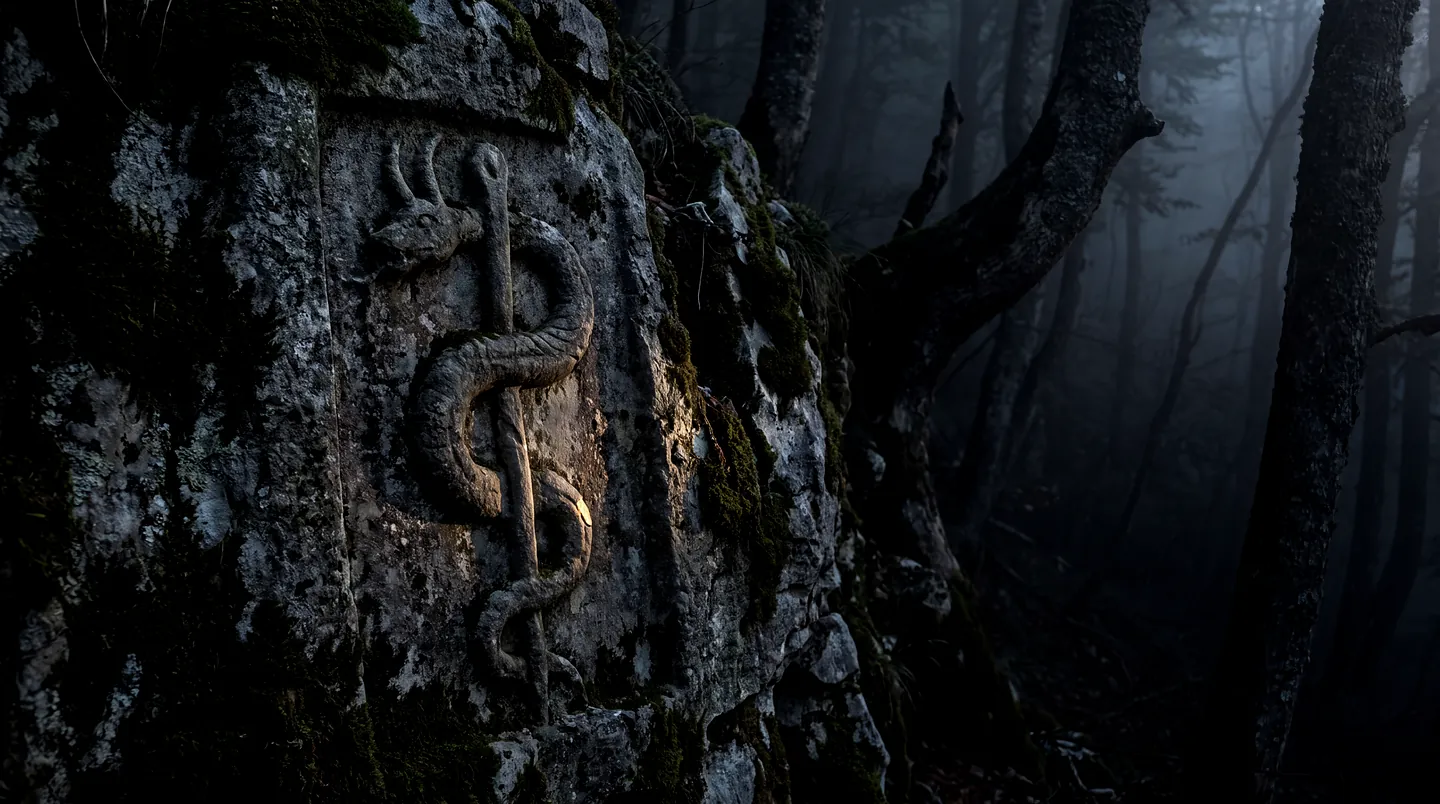
Pečat Lucifera

Crni Hram

World Satanism, in the Balkans too

“They called him Prometheus, Lucifer, the serpent, Veles.
The charge is always the same: he brought light to mankind.
The verdict, this time, is ours to write.”

Non-theistic Free of superstition Public and lawful No guru, no membership fee Est. MMXXVI
Read the manifesto Symbols
I · The word before all words

Manifesto

To the Balkans, the gods always came from elsewhere. From Rome, from Constantinople, from Istanbul, each with its own army, its own tax and its own hell. And every one of those powers did, before anything else, the same thing: it took what had grown here out of the soil and declared it the Devil.

Perun fared well. A thunder god is useful to any power, so he was merely re-dressed: he was given a prophet’s beard and the fiery chariot of Saint Elijah, and kept his place in the sky. But Veles, god of roots and cattle, of wealth and wool, of song, of trade and of the oath; god of everything an ordinary man has and everything he fears to lose, Veles was pushed underground and named the enemy. Our oldest god became our first devil. This is not theology. This is politics, a thousand years old.

We do not believe in the Devil. Nor do we believe in Veles as some horned old man seated beneath the roots of the world. We believe in what that figure remembers: that nothing forbidden to you is evil for being forbidden, and nothing commanded of you is good for being commanded. That behind every sermon on obedience someone’s interest lies hidden. And that a man who thinks with his own head is, in every century, in every language and in all three scripts, given the same name: demon.

Here the oldest god is called neither God nor Allah. Its name is: šta će selo reć (what will the village say). The First Truth of Crni Hram

To that god the greatest sacrifices in the Balkans are offered: loveless marriages, lives never attempted, talents buried in the front pew of the church, the silence across the table that only rakija thaws, so that by morning it is all forgotten again. To that god we renounce our obedience. The village may say what it likes. The village always talks anyway.

We touch no one’s grandmother nor her candle; her candle is her freedom, and before it we bow. We touch those who wear the cross at the throat and thievery in the hand; who fast before the cameras and slaughter behind them; for whom faith is a jersey and God a terrace chant. Hypocrisy is the only sin this temple recognizes.

Of all that the centuries have left us, two words we keep like fire. Inat (defiant spite), the strength to stand when you are ordered to kneel. And merak (deep, savoured pleasure), the courage to relish a life you were told is a vale of tears. Inat without merak turns to poison; merak without inat turns to sloth. Together they are the one thing no power on this peninsula has ever managed to tax.

This order has no nation. Veles is older than Croats, Serbs and Bosniaks, older than all our names; older than the schisms and the ruptures; older than borders that change owners like a tavern table. Whoever makes blood a flag has no place here. Our blood is red like everyone’s, and that is the whole of our theology of blood.

We offer no salvation, because we do not sell fear. We offer no paradise, because we charge no admission. We offer what Veles always guarded: wealth earned by work, a word that is kept, a song sung at full voice, knowledge seized like fire, and peace with death, with no blackmail of eternity.

In the old treaties the warriors swore by Perun, and the merchants and common folk by Veles. To swear by Veles meant: I swear by my wealth, by my labour, by my obraz (my honour, my face before others), by everything I can truly lose. That is why it is the only oath we recognize. Not before heaven, but before yourself: that you will not kneel where you can stand, that you will not stay silent where you can speak, and that you will not spit on another’s freedom to make your own look larger.

The temple has two wings. One looks to the sky before dawn, to Danica, whom the world calls Lucifer: to light, to knowledge, to walking upright and the price that exacts. The other looks to the earth, to Veles: to the root, to wealth, to song and to the oath. We are Balkan by our roots, and of the world by the light we follow; whoever thinks the two exclude each other has never looked at a tree.

This is Crni Hram. Black not because it worships the dark, but because it is built from everything that was cast into the dark: the old god, the body, knowledge, the disobedient thought. A temple because it is a place of gathering and of rite, a stance and not a building. To the world we speak the language of Satanism, to the Balkans the language of its own roots. Welcome home, if you have ever, anywhere, been one too many. Here, being one too many is the measure of a person.

II · The Name They Gave Us

Satanism, As It Truly Is

Forget the films. No one here slaughters roosters, draws a circle in the basement, or waits for a horned master. Modern Satanism is a philosophy for grown-ups: without superstition, without kneeling, with a mirror instead of an altar, and with a better sense of humor than it is ever given credit for.

A Word That Was an Accusation

The Hebrew satan means, quite simply: adversary, accuser. A function in a court of law, not a name on a baptismal certificate. For centuries no one called themselves by that name; the authorities used it to name others: heretics, witches, old women with their herbs, scientists, dancers, poets, anyone who stood out. “Satanist” was a label pasted on just before the stake.

Modern Satanism makes the one move that strips such a label of its power for good: it takes the label into its own hands. If the “adversary” is everyone who refuses to kneel, then fine. Here is your adversary. To claim an insult and wear it like a coat of arms: that is the old school of dignity, and it is how we recognize our own.

No One Here Believes in the Devil

The first thing every serious Satanic movement in the world says about itself: Satan is not a being but a symbol. There is no horned one, no hell, no contract signed in blood. This is not our exception; it is the rule of the entire modern tradition, from the first public Church of Satan to the activist temples of today.

We believe in neither God nor the Devil. We have simply outgrown that part; the world has quickened its pace, and superstition is baggage no one is left to carry. It is easier and more honest to live this way. Word of the Crni Hram

“Devil worshippers” exist mainly in two places: in horror films and in police panics that later fall apart in court. The great “Satanic panic” of the eighties shook half the world and ended without a single proven cult, but with a heap of ruined lives among the accused. We remember that episode twice over: as proof that the Devil does not exist, and as proof that the hunt for the Devil most certainly does, and that it always hunts people.

What a Satanist Truly Values

Reason Before Authority

No title, no cassock, no uniform turns a claim into truth. Evidence is the only authority that does not demand kneeling. When we err, and we will, we change our position, not the evidence.

Your Body Is Yours

Exactly one person gets a vote on your body: you. Not the state, not the church, not the family, not the algorithm. And that holds for everyone, including those whose choices you do not understand. Autonomy only for the like-minded is not autonomy but a club.

Freedom, With a Bill to Pay

Do what you will, and pay for what you do. Freedom without responsibility is spoiled indulgence; responsibility without freedom is slavery. A Satanist does not ask permission, but neither does he flee the bill. The bill is signed with one's own name.

Compassion Without Command

Goodness on command is merely obedience with a smile. We choose compassion, because it is wise, because it builds, and because it is ours. Empathy with a spine: warm toward the human being, cold toward manipulation.

Justice Above the Paper

Laws were written by people, often the very people they serve. When justice and the paper part ways, we know where our loyalty lies. Publicly, loudly, and without violence, but without retreat either.

Laughter as a Weapon

Tyranny endures everything except ridicule. That is why humor in this temple is a liturgical category: whoever laughs does not kneel, it is physically proven that the two cannot be done at once.

A Brief History in Seven Cuts

  • 1667.Milton publishes Paradise Lost. For the first time Satan speaks as a tragic hero with the finest monologues in the epic, and the poets take note.
  • 1790-eBlake and the Romantics read Milton against the grain, and rightly so: “hell” becomes a cipher for energy, the body, and the imagination, Lucifer a cipher for freedom against tyrants.
  • 1891.In the novel Là-bas, Huysmans invents the aesthetic of the Black Mass for decadent Paris, an aesthetic Hollywood would later sell as documentary fact.
  • 1966.San Francisco: the first public Church of Satan is founded, atheistic from day one. Satan as a symbol of pride, the body, and individualism; ritual as psychodrama.
  • 1980-e“Satanic panic”: a global moral panic without a single proven cult. A textbook example of how an enemy is manufactured, and of who profits from it.
  • 2013.The activist wave: non-theistic temples begin using legal means and public humor to defend the separation of church and state, bodily autonomy, and minorities.
  • 2026.Crni Hram: the Balkan cut of the same story, with Veles in place of an imported devil, because ours is older and ours was at home from the very beginning.

Good? Yes. And Here Is the Measure.

Goodness is not proven by declaration but by the balance sheet. Measure every system, ours included, by three questions: does it ask of you fear or courage? Ignorance or knowledge? Submission or responsibility?

A system that lives off your fear, your ignorance, and your submission, call it whatever it calls itself, is bad by its fruit. A philosophy that tells you: think with your own head, govern yourself, defend the weaker, enjoy without doing harm, and kneel to no one, call it the worst name you have. By its fruit it is good. We call it Satanism, because others gave us that name, and we have washed it, polished it, and put it back into circulation brighter than it arrived.

III · The Lightbringer

Lucifer Is Good

The name they frightened you with literally means: the one who carries the light. In Latin, Lucifer; in Greek, Phosphoros; in our own tongues, Danica. A star your grandmother knew by name, one the people sang songs about.

A Star, Not a Criminal

Lucifer was astronomy before anything else: Venus when it rises before dawn, the last and brightest light before sunrise. The Romans called it lucifer, the lightbringer; the Greeks heosphoros, the bringer of dawn; our own people called it Danica and told the hour of rising by it. Not one of those names was a curse. Every one of them was a compliment.

The indictment was written later, by way of translation: in Isaiah a taunt against the king of Babylon, “how you have fallen from heaven, shining son of the dawn,” was rendered into Latin with the word lucifer, and so later writers fused the star with the fallen angel. That is how the morning star ended up with a court file for someone else's deed. Remember that procedure, because we have seen it with Veles too: first they take your name, then they try you under it.

The Fall as the Price of Light

In every myth worth anything, light is not handed down for free from above; someone brings it, and someone pays. Prometheus steals fire: the rock and the eagle. The serpent in the garden speaks the one verifiable sentence in the story, “you will know,” and banishment follows. Lucifer says “I will not serve”: the fall. Always the same contract, in fine print: knowledge is paid for with comfort. Satanism, in a single sentence, is the decision that this price is fair.

Better to reign in Hell than serve in Heaven. John Milton · Paradise Lost · 1667

The Enlightenment Under Another Name

When Kant boiled the Enlightenment down to two words, sapere aude, dare to know, he wrote a Luciferian manifesto with the gloves still on. Every school, every library, every printing press, every vaccine: all of it is stolen fire, knowledge wrested from those who kept it under lock and key “because it isn't for you.” Blake wrote of Milton that the true poet, without knowing it, takes the devil's side, because in that division the devil's side was always the side of the question, the body, and the light.

So we say it calmly, without smoke and without apology: Lucifer is good. Not as a being, there is no being. As a direction: toward the light, upright, at the full price. Whoever carries the light is ours; whether it signs itself Danica, Prometheus, or enlightenment is a matter of handwriting.

Danica, Our Lucifer

And here the two wings of this temple meet. Danica in the sky before dawn; Veles in the roots beneath the earth. The West sang its lightbringer in epics and burned him in the town squares; we kept ours in lullabies, in the round dance, in the names of our daughters, and so it never even occurred to us to fear him. The same story at both ends: the brightest thing and the deepest thing were both declared dangerous, and both survived anyway. On that alliance of the sky before dawn and the earth below the roots stands everything we build here.

IV · No fog

Who we are. Who we are not.

Before anyone misreads a single thing: this is a page that does not hide behind smoke. Everything we are and everything we are not stands here, in the open, in plain language.

We are

  • A non-theistic movement. We do not believe in gods, devils, spirits or an afterlife. Not one of our texts asks you to believe in the supernatural.
  • A philosophy with ritual. We take the best of what religion knows, symbol, calendar, rite, community, and strip from it the blackmail of fear.
  • A world movement, a Balkan address. Satanism is global; we translate it and show it to the Balkans: through Slavic mythology and the experience of this place, without a trace of the nationalism that has profited off that experience.
  • Public and lawful. Everything we do is fit to be seen. We invoke the freedom of thought, conscience and religion, the very same that protects the church across the street.
  • Open to doubt. Every sentence on this page may be called into question. We ask that of you, and most of all of ourselves.

We are not

  • We do not worship Satan. Nor Veles. We worship no one; we do not believe those beings exist. The archetype is a mirror, not a master.
  • We are not a cult. There is no leader to answer to, no membership fee, no secret ranks, no isolation from family, no penalty for leaving. The door is open both ways.
  • We do nothing unlawful. No “blood sacrifices” of any kind, animal or otherwise. Whoever comes looking for that has the wrong address and the wrong century.
  • We are not against believers. We are against institutions when they trade in fear and power. Your grandmother, her rosary and her peace are sacred to us too.
  • We are no one’s jersey. Not a party’s, not a nation’s, not a subculture’s. We wear black because it suits us, not because someone ordered us to.

Violence is not our language, in anyone’s name

We say this without a single caveat, because it matters more than anything else on this page. Whoever kills, rapes or sows terror while shouting the name of some god, no matter which, that person is not ours, not remotely. He is living proof of the very hypocrisy this temple has stood against since its first sentence: bloodlust dressed in the holy, cowardice demanding to be worshipped. Our contempt for such evil is total and unconditional, equal under every flag, every cross, every crescent and every banner, without exception and without discount.

The Satanism we build here knows no holy war, no vengeance, no terror, no hand raised against an innocent. The freedom of another is as sacred to us as our own, and the life of the innocent stands above every idea, every faith and every insult. Whoever reads these words looking for an ally in violence has come to the wrong door: to such a one we are the adversary, and so we remain for as long as we exist.

V · The God They Shoved Underground

Why Veles?

Every culture that wanted a different shape for everything reached for a figure the powers that be had denounced. The West took Lucifer. We have nothing to import, we have an older one, our own, and with papers to prove it.

The God That Words Swore By

In the oldest East Slavic sources Veles (Volos) bears the title skotji bog, the god of cattle. Today that sounds modest, until you recall that for thousands of years cattle meant the only real wealth of the common man: food, wool, the strength to plough, a dowry and an inheritance. To this day the word blago in our languages means both “cattle” and “treasure,” that is Veles's signature in the language itself. In the tenth-century treaties of Kievan Rus with Byzantium the princes and warriors swear by Perun, while the merchants and the common folk swear by Veles. Perun was the god of those who rule. Veles was the god of those who work.

Alongside cattle and treasure, Veles also holds the invisible treasure: song, memory, and craft. In The Tale of Igor's Campaign the legendary singer Bojan is called Veles's grandson, poets, then, are his offspring. God of the underworld, god of the herd, god of the word that is kept and the song that is remembered: everything the village truly rests upon, while the thunder overhead only collects its due of awe.

How a God Becomes a Devil

When the new faith arrived with armies and charters, the pantheon was treated like a defeated army: the officers were offered new ranks, and the inconvenient ones were shot in the myth. Perun, the thunderer at the top of the world, was reclothed as Saint Elijah, who to this day thunders across our villages and drives a chariot of fire. To Veles, as the god of cattle, one layer of folk piety assigned the role of Saint Blaise (Vlaho), protector of the herd; it is no accident that the saint's cult took root so deeply on our own coast. But his other, deeper layer, the underworld, magic, wild knowledge, everything that cannot be supervised, that layer was given horns and a tail. In the folk Christianity of our lands the devil inherited Veles's place, Veles's domains, and Veles's underworld.

Remember that mechanism, because it is the whole point of this page: demonization is an administrative procedure. You do not become a devil because you do evil. You become a devil because the new power needs you as the villain, because what people seek from you (treasure, the body, knowledge, song, freedom) it cannot charge them for. This happened to a god. It happens to people every single day.

The Serpent in the Roots of the World

Scholarly reconstruction, and it is only fair to say that it is a reconstruction, not a preserved text, places a duel at the very heart of Slavic mythology: the thunderer Perun at the top of the world tree, the serpentine Veles in its roots. Veles climbs, steals cattle, water, or people; Perun strikes him with lightning; Veles hides under a stone, under a tree, under a man; the rain falls, the world is renewed, and it all begins again. Rule and root, order and wildness, above and below, not good and evil, but two poles without which the world does not run.

The churches later retold that duel as an archangel trampling a serpent. We read it closer to the original: every power calls itself heaven, and calls everything it cannot control a serpent. We are, thank you for asking, on the side of the roots, because everything grows from the roots, while from the top there is only thunder.

Why We Take Him as a Sign and Do Not Worship Him

Veles is not a god we light candles for. Veles is our map of our own values, drawn a thousand years ago:

  • Treasure, property earned by work and trade, not by plunder. Hence the root of obraz and labour.
  • Wool and herd, care for that and those entrusted to you. Hence community without the pack.
  • Song and memory, Bojan's inheritance. Hence sevdah, the round dance, and the book in the same temple.
  • The oath, the word merchants and common folk swear by, because they have something to lose. Hence obraz is our law.
  • The underworld, death as part of the circle, not as a cudgel for obedience. Hence the root of earth.
  • Horns and serpent, everything power declared a devil and the people never stopped needing; everything shoved into the black so it could be ruled more easily. Hence the name: Crni Hram.
We do not bow to Veles. We rise upright with him, from the same root. The Second Truth of Crni Hram
VI · Principles

The Nine Roots

Commandments are issued from above. Roots grow from below. That is why these are not commandments but roots: you do not have to obey them, but if you live them, they will hold you upright even when the wind blows.

I

Root of inat

“When they order you to kneel, standing becomes a prayer.”

Inat is our oldest faith: the strength to stay yourself when they break you with numbers, force, or habit. But tell the holy inat from the foolish one. The inat that defends your freedom and another's dignity is sacred. The inat that burns down your own house just to spite the neighbour is a sickness, and it is the very one this peninsula is dying of. Our inat builds, it does not tear down; it stands, it does not scream; and it never kneels out of habit.

II

Root of merak

“The body is not a sin. The body is the only temple you were given at birth.”

They told you life is a vale of tears and that pleasure must be confessed. We say: merak is worship without a god. A coffee drunk slowly, a song sung at full throat, love without shame, a table shared with people you chose yourself, these are not weaknesses but proof that you are alive. Moderation, yes: out of wisdom, because addiction is a new master. But shame? Give shame back to those who invented it so they could sell you absolution.

III

Root of reason

“‘Believe’ is not an argument. Doubt is a higher form of respect for the truth.”

Everything may be questioned. What may not be questioned, question that first. Science is not our church but our tool: the most honest way of being wrong less and less. When evidence and dogma collide, evidence wins; when evidence and we collide, we are the ones who change. Falling for a con is not naivety but laziness, and in the Balkans gullibility has for centuries cost more than earthquakes.

IV

Root of obraz

“An oath is worth as much as the man. A man is worth as much as his oath.”

The common folk swore by Veles because they swore by what they could lose: treasure, labour, obraz. Obraz is not washed clean in church on Sundays, obraz is washed clean by conduct, every single day. The word you gave holds even when no one is watching and even when it costs you dearly; otherwise you gave not a word but a sound. Better to lose everything and stay yourself than to gain everything and no longer answer to yourself.

V

Root of the village

“The village is not a god. Its silence is not peace, and its murmur is not a verdict.”

What will the village say, the oldest Balkan shackle, the only one each generation forges for itself. Community we love: the gathering, the table, the people who hold you up when you fall. But a community that holds you by fear is not a community, it is a pack with better manners. Your life is not a public debate. The village will talk in any case, so let it at least have something to talk about.

VI

Root of blood

“Blood is not a flag. You owe no one hatred as an inheritance.”

Here faith has for centuries been worn like a team jersey, with God cheering from the stands. Three names, three scripts, the same handwriting of power, and always the same bill: other people's children pay it. Crni Hram is supranational or it is nothing. Veles is older than all our divisions, and to the dead of our wars it makes no difference who lit a candle for them. Love your own, cherish your language and your song, but the moment your love for your own demands another's fear, it has stopped being love.

VII

Root of justice

“Where law and justice part ways, justice is the older one.”

The hajduk is our archetype for a reason: when an institution becomes robbery with a stamp on it, someone has to take to the hills, if only the inner ones. But read carefully: our resistance is public, loud, and lawful. We do not burn, we do not threaten, we do not raise a hand, because violence is the currency of the very people we stand against. Justice without mercy turns into revenge, and revenge is the most expensive Balkan sport. To defend the weaker against the stronger: that is the whole liturgy of this root.

VIII

Root of fire

“All knowledge is stolen fire. Steal it every day.”

In every myth the same crime: someone takes fire, an apple, the written word, and hands the people what was reserved for the gods. And in every myth punishment follows, because a literate slave is only half a slave. The serpent from the garden spoke the one verifiable sentence in that story: you will know. So: read, question, verify, learn a trade, learn a second, pass it on. Ignorance is not innocence. Ignorance is a prison in which you are your own jailer.

IX

Root of earth

“Death is not a punishment. Death is the reason to put nothing off.”

We will not sell you heaven or threaten you with hell, that is the oldest blackmail on the market. Death is the root into which we all descend, and precisely for that reason every day before it is worth its weight in gold. Sevdah is our science of this: the art of feeling grief all the way to the bottom and making a song out of it, instead of burying it so it poisons you. Whoever has made his peace with death can no longer be ruled. That is exactly why you must not think about it, say those who would rule.

VII · Reality, drawn in a single line

Symbols, the language that does not lie

A symbol is the oldest way to carry a truth in your pocket. Here is our mark, and the shared language of Satanism: old, genuine, explained without fog. What it is, where it comes from, and which reality of life it holds.

The Mark of the Black Temple

Pečat Lucifera

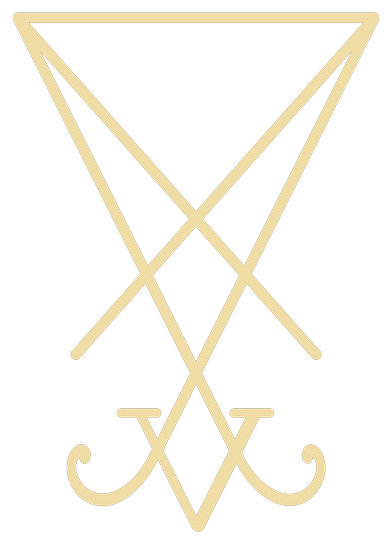
Our mark is not invented. It is the Seal of Lucifer, the seal of the light bearer from the grimoire Grimorium Verum (18th century), a sign the world has recognised for centuries. We took an old and genuine mark rather than drawing our own, because truth needs no new logo. Its exact meaning no scribe ever wrote down; the mages drew it as the seal of the one who carries the light. We read it like this:

  • The chalice at the base, the vessel that catches the light: everything you are given, you must also know how to keep.
  • The crossed paths in the centre, above and below meeting in a single point: Danica in the sky and Veles beneath the roots, joined by one hand.
  • The point turned upward, the ascent: knowledge is not handed down from above as a gift, it is seized and climbed toward.
  • The sign of the morning star, the last light before dawn, a name they turned into an accusation, and we into a banner.

Colours

Black, everything they cast into the dark, which then learned to see in the dark. Old gold, treasure, grain and wax: value that is earned, not inherited. Red we use sparingly, the way the old folk used red thread against the evil eye: for warnings, not for ornament.

The shared language of the dark

These are original signs, genuine, from the grimoires, alchemy and the old astronomy, not our inventions: the Seal of Lucifer, the Leviathan Cross, the inverted pentagram, the inverted cross, the star of Ištar. They have been redrawn by our own hand into a clean, hard line. Not one of them “summons” anything, each one remembers something. And beside each stands the thing that matters most: which reality of life it holds.

Pečat Lucifera

Seal of Lucifer

An original seal from the old grimoires (Grimorium Verum, 18th century): the chalice of light, the crossed path, the grain at the base. Today the most recognisable mark of the light bearer in the world, and the mark of this site. It summons no one; it signs those who have chosen knowledge that comes with a price.

Reality: light is held like a chalice: with both hands, out in front of you. And it is not spilled on just anyone.

Grimorium Verum · 18th century

Alkemijski znak sumpora

Leviathan Cross

The original alchemical sign for sulphur: a double cross above the symbol of infinity. In the old chemistry sulphur was “the fuel of hell”, a substance that burns of its own accord. Modern Satanism took it as the sign of its own engine: an energy that needs no outside spark and no one else's permission.

Reality: infinity stands at the bottom, as the foundation: what drives you must be your own. Otherwise you are someone else's fuel.

Alchemical sign for sulphur · Leviathan Cross

Čovjek upisan u pentagram, Agrippa, 1533.

Pentagram

Five points, one unbroken line: the four elements and a fifth, consciousness, which holds them together. To the Pythagoreans a sign of health, to Renaissance scholars a drawing of a man with arms outspread, for millennia a sign of protection. It was declared fearsome only by the one who was troubled by the man in the middle.

Reality: the human being is the measure of this temple: the five fingers of the hand that works, embraces and signs.

Agrippa · De occulta philosophia · 1533

Obrnuti pentagram, Stanislas de Guaita, 1897.

Inverted pentagram

The same sign, its point toward the earth: matter before abstraction, the body acknowledged as a home, not as the soul's luggage. It was pronounced “infamous” only by the moralists of the nineteenth century; until then it was merely geometry.

Reality: begin with the real: with the body, with bread and with the bill. Only then theorise.

S. de Guaita · La Clef de la Magie Noire · 1897

Obrnuti križ, Petrov križ

Inverted cross

Two readings, both true. The older: the Cross of Peter, the sign of a man who did not consider himself worthy to die as his teacher did. The newer, out of heavy metal and the street: an imposed order turned on its head, a sign that every hierarchy may be questioned from below. We wear it in that second reading: not as an insult to anyone's grandmother, but as a question put to every authority.

Reality: turn every “eternal” order upside down and watch: what still stands even upside down has worth. What falls was held up by fear alone.

Cross of Saint Peter · traditional form

Osmokraka zvijezda Ištar

Danica, the star of Ištar

An eight-pointed star, the original and oldest recorded sign of Venus: five thousand years old, from the clay seals of Mesopotamia. The morning star before dawn; in Latin Lucifer, the light bearer, in our own tongue Danica. Our people gave her name to their daughters; others wrote indictments against her.

Reality: the announcement of light while it is still dark. Whoever sees her is already awake, and that is the whole secret.

Star of Ištar · Mesopotamia

Ouroboros, zmija koja grize svoj rep, 1625.

The serpent that bites its own tail

The Ouroboros: a circle with no beginning, renewal without permission. The serpent sheds its skin in order to grow, and that is why in every story it is the keeper of knowledge. In the garden, by the way, it told the truth: you will know.

Reality: growth is a steady shedding: of habits, of convictions, of a version of yourself. It hurts exactly as much as it needs to.

Ouroboros · L. Jennis · 1625

Prometej donosi vatru ljudima, Heinrich Füger, 1817.

Torch

Prometheus' fire in a human hand; the sign of enlightenment before enlightenment was given ministries. A light passed from hand to hand that asks no one's leave, which is why it is on every list of the forbidden.

Reality: every piece of knowledge you have, someone once paid for. The debt is repaid with a single act: pass it on.

H. Füger · Prometheus Brings Fire · 1817

Bik Apis sa sunčevim diskom među rogovima

Horns and disc

Veles' signature: the strength that ploughs, the wealth that is counted, the moon that waxes and wanes above the stable. A sign as old as the first domesticated animal, demonised the moment a new authority needed a villain who came with an inventory.

Reality: property earned by work and pride without apology. Those two owe no one a confession.

Apis · bull with a sun disc · bronze, Egypt

Divlji jarac iz Qazwinijeva rukopisa, 13. stoljeće

Goat

The animal that climbs where the sheep dare not go and eats what others refuse. And the “scapegoat”, a phrase older than all today's churches, is the animal onto which the sins of others are loaded before it is driven out into the wilderness. Sound familiar?

Reality: society always finds its scapegoat. We are the goats that stopped consenting; that is how you know us.

al-Qazwini · The Wonders of Creation · 13th century

Bafomet, Éliphas Lévi, 1856.

Bafomet

Lévi's drawing of 1856: a goat's head, an angel's wings, a body both male and female, the torch of knowledge between the horns. Not a devil but an image of balance, the union of everything others split into good and evil. On the forearms stands solve et coagula: dissolve and then bind, understand and then build.

Reality: wholeness is not chosen piece by piece. Male and female, above and below, reason and instinct, all of it fits inside one person who has stopped apologising.

É. Lévi · Dogme et Rituel de la Haute Magie · 1856

Svijećnjak s nogom u obliku satira, Roëttiers, 18. stoljeće

Black candle

A light that burns for you, not for show. It is lit when a decision is being made, not when one is being performed. Black because it promises nothing, except your own, undivided attention.

Reality: an hour of silence beside a single candle is worth more than a thousand posts. Verifiable this very evening.

Candlestick with a satyr · Roëttiers · 18th century

666

Six hundred and sixty six

In Revelation “the number of a man”, according to most historians a numerical cipher for the emperor Nero, the persecutor: a political message in code, written for readers who knew how to count. Pop culture turned the cipher into a brand, and fear into marketing.

Reality: behind every “cursed number” stands some emperor. Learn to read the ciphers; every one of them, without exception, is political.

Pečat Salomona iz Ključa Salomonovog

Sigil

An intention condensed into a sign: you draw a decision, then carry it until it becomes reflex. No magic at all, a summary with a signature. The one here is the Seal of Salomon from an old grimoire; the true sigils await you further down, and let your own look however you please.

Reality: a signature, a logo and a wedding ring are already sigils. The only question is who drew them: you, or someone else for you.

Seal of Salomon · The Key of Salomon

Every image here is an original historical source in the public domain, from grimoires, alchemy and the old astronomies, cast into our own gold. Take them, wear them, share them, only do not lie with them.

Sigils, the seals of the grimoires

A sigil is the oldest way to lock an intention into a drawing. Medieval sorcerers believed that every spirit had its own seal and could be summoned by it; we do not believe in summoning, but before the mastery of these lines we take off our hats. These are the original seals from The Key of Salomon (Ars Goetia) and the Grimorium Verum, just as hands copied them over the centuries. They summon nothing. They show everything: that a human being could turn even his greatest fear into geometry, catch it in a circle and so strip it of its power.

Pečat Lucifera, Grimorium VerumLuciferthe light bearer, full seal
Pečat BaelaBaelthe first king, invisibility
Pečat BelethaBelethking, love and will
Pečat AsmodayaAsmodayking, craft and geometry
Pečat GaapaGaapprince, knowledge and speed
Pečat BelijalaBelijalking, freedom without a master

Seals from The Book of the Goetia of Solomon the King (ed. 1904) and the Grimorium Verum, public domain. They stand here as heritage, not as instruction.

What we do not use, and why

  • The Sigil of Baphomet (a goat inscribed in an inverted pentagram) is a registered trademark of the Church of Satan; that one we do not take as our own. Lévi's historical drawing of Baphomet from 1856 is public domain, and that one we show freely, above among the symbols.
  • Anything that calls for violence. Whoever pastes our mark next to hatred has, by that very act, stripped it from himself.
VIII · Language is older than the church

A Balkan Lexicon of the Sacred

We never needed consecrated words out of foreign books; the people forged their own long ago. Here we return them to the altar: twelve words that are our true liturgy.

Inat

The refusal to be broken, even when giving in would come cheaper. Misunderstood, it razes homes and nations; understood rightly, it is the only reason we are still here. In the Crni Hram, inat is a defensive weapon: drawn against tyranny, never against your neighbour, and never against yourself.

Merak

A deep, slow delight in small things: the first coffee, the evening light, a kind word. Merak is proof that holiness asks for no cathedral; a balcony and ten minutes of peace will do. A person who has merak is harder to buy, which is exactly why they declared it a sin.

Ćeif

Merak's stubborn brother: a thing is done the way you want it done, at your pace, in your order, or it is not done at all. Ćeif is small, everyday sovereignty. Empires came and went; ćeif stayed unconquered, because it cannot be entered into any land registry.

Sevdah

Sorrow that does not hide but sings. The sweet weight in the chest when you love, lose and remember, all at once. Other cultures treat grief with silence or a pill; we made an art of it. Sevdah is proof of the ninth root: you do not flee from mortality, you compose from it.

Obraz

Honour that shows on the face because it is worn on the face. Obraz is not inherited, not bought, and not returned on sale; it is lost with a single signature and earned over years. Our only deed of property: everything else, they can take from you.

Prkos

Inat in its work clothes. Prkos is when you rise at dawn and do well the very thing they said you could not, must not, was not meant for you. The purest form of prayer we recognise: proof by deed, against the prophets.

Hajduk

An archetype: the one who takes to the hills when power becomes robbery with an official seal. Half brigand, half saint, the people sang of him because he spoke what everyone else swallows. We take the symbol, not the method: our hills are the public word, the court, the permitted street and one's own table.

Jal

Our true national disease: the ache at another's success. Jal is the only “supernatural” evil we acknowledge, because it genuinely ruins harvests, marriages and businesses. The ninth prayer of the Crni Hram goes: let it go well for me and for him. To say it and mean it is the ascetic feat of these lands.

Sijelo

Community at its finest: people gather in the evening, with no agenda, with song, with work and with talk. No one presides, no one charges a fee. Our answer to the church pew: a circle, not a column. The kolo is the same theology, only faster.

Sofra

The table you sit around until the thing that matters is finally said. At the sofra one Balkan law holds, older even than inat: the guest is sacred, whoever he may be. Hospitality is our oldest ethic, born before all three faiths, and it will outlive them all.

“Šta će selo reć”

The one omnipotent force of the Balkan pantheon. Invisible, all-knowing, eternally displeased. To it are sacrificed marriages, careers, departures and returns. The Crni Hram is, strictly speaking, atheism toward precisely this deity; everything else is a footnote.

Promaja

The only supernatural being the Balkans truly believe in, without a single apostate. It passes between two open windows and mows down generations. We list it here as a reminder that even the hardest rationalism has to surrender somewhere, and that it is healthy to laugh about it.

IX · Creatures out of the dark, truths out of the mirror

Pantheon of the Shadow

We do not believe a single one of these beings exists. We believe every one of them knows something. The people were not fools: when they had no word for a fear, they carved a face for it. Here are twelve faces, and the twelve truths they keep.

Veles

Myth: god of cattle, of wealth, of the underworld, of magic and of song; the serpent in the roots of the world tree; Perun's eternal adversary. After the conversion, the devil.

Mirror: whatever power cannot tax, it will declare devilish. Your work, your pleasure, your knowledge and your word, keep them down below, in the root, where the thunder does not reach.

Morana

Myth: goddess of winter and death. Every spring the people burn or drown her body of straw, so that summer may be allowed to come.

Mirror: nothing new begins until the old has burned, a relationship, a job, a version of you. The people knew what therapy bills by the hour: an ending needs a rite, not an excuse.

Crnobog i Belobog

Myth: the black god and the white, the shadow and the light of the world. The chroniclers recorded that they were worshipped together, because good without evil has no shape.

Mirror: darkness is not evil; darkness is one half. Whoever promises you a world without shadow is selling you the most expensive lie on the market. A whole person knows both of their colours and apologises for neither.

Vila

Myth: the wild woman of the hills and the waters; she dances in the kolo, she heals and she wounds, she takes heroes as sworn kin, and whoever tramples her ring fares badly.

Mirror: a woman's freedom that asks no permission. The village called her dangerous by exactly as much as it needed her to be. Do not trample another's ring: every woman's body, choice and path are her own hills.

Vampir

Myth: a corpse that returns and drinks the living. The one word the Balkans gave to every language on earth, exported from our villages after cases like that of Petar Blagojević (1725.), about which Viennese officials filed formal reports.

Mirror: whatever you bury unresolved returns and drinks. Guilt, debt, a wrong left unspoken, it makes no difference. And a second thing, more important: all of Europe believed that panic once it bore an official seal. Mass hysteria has a signature and a protocol; learn to recognise them.

Vukodlak

Myth: a man who turns into a wolf. In the older stratum of our lands the vukodlak and the vampir were one and the same being, the wolf is merely the older skin.

Mirror: the beast in you exists; the only question is who holds the chain. Whoever denies his beast becomes it without warning. Whoever knows it, feeds it and leads it has strength without shame.

Drekavac

Myth: a creature that shrieks by the stream at night; by tradition, the soul of a child that died unbaptised.

Mirror: listen to what that myth actually admits, that there is a doctrine ready to condemn even a newborn, for the discipline of the living. Any system that sends the innocent into the dark to keep you in line has written its own verdict. The drekavac does not shriek at you. It shrieks for you.

Baba Roga

Myth: the bogey of the nursery: “be good or she will carry you off.” A kinswoman of the great crone of the forest, Baba Jaga, who in the fairy tales both devours and bestows.

Mirror: the first lesson in obedience arrives not from church nor from school, but from the dark under the bed. Power trains the fear while you are small, so that later it need only give it a bigger name. Growing up is the act of turning the light on Baba Roga.

Mora

Myth: a night creature that sits on the chest of a sleeper and allows neither breath nor movement. It entered other languages too: nightmare carries the very same being in its name.

Mirror: with this figure the people described sleep paralysis exactly, centuries before neurology. The lesson is twofold: fear always sits on the chest of the one lying down, and a myth is often a diagnosis that does not yet have a Latin name.

Karakondžula

Myth: a hideous being that runs riot in the “unbaptised days” between Christmas and Epiphany, in the nights that, by the folk reckoning, belong to no order at all.

Mirror: the calendar too has a shadow. A system that claims to cover everything admits a hole of twelve nights, and into that hole it sets a monster, so that no one takes a look inside. That is exactly where we look: where “it's no good,” there you see the most.

Zduhač

Myth: a man whose spirit leaves him in sleep to defend his field against the powers of the storm and against rival zduhači, while his body lies as though dead.

Mirror: a protector does not look like a hero; by day he is an ordinary, tired man. The greatest battles for your home are fought where no one applauds. Be someone's zduhač, and know how to recognise your own.

Bauk

Myth: a being that is never described, that lives in the dark, in a hole, in an abandoned house, and waits. Fear with no face and no shape.

Mirror: the strongest power is the one no one has ever seen: “it can't be done,” “it isn't allowed,” “everyone knows.” The bauk rules until you approach it with a lamp. Nine bauks out of ten are a chair with a coat thrown over it, and for the tenth you have your reason and your people.

X · Theatre for a single spectator

Rituals as Psychodrama

Not one of our rituals summons anything or begs for anything. A ritual is theatre performed for exactly one spectator: your nervous system. A candle, a fire and a set form of words do what an athlete's pre-game ritual does, they gather attention into a single point and give a decision a weight that ordinary thought cannot.

Three rules before all else: nothing unlawful, nothing that harms you or another, nothing living is ever offered up, never and nowhere. Fire only outdoors or in a safe vessel, well away from dry brush, with water at hand and in accordance with local regulations. Whoever turns a ritual into an excuse for harm is not one of us.

Black Coffee

Every day10 minutesCoffee or tea
  1. Brew the coffee slowly, the way it is meant to be brewed, not the way you can snatch it.
  2. Sit alone. The phone goes in another room; it has gods of its own.
  3. While you drink it, do only that. First sip: what today I must do. Second: what today I want to do. Tell those two apart, down to the bottom of the cup.

Why it works, ten minutes of undivided attention a day is training for the same muscle with which you resist both fear and advertising. Here the coffee cup is older than all the churches; we return it to service.

The Toast

As neededBefore witnessesA glass of anything
  1. Rise at the table when you are deciding something important, a job, a departure, a beginning.
  2. Say it aloud, in the first person and the present tense: what you are doing and by when.
  3. Clink glasses, drink, sit down. From that moment the word belongs no longer to you but to the table.

Why it works, an intention spoken in public puts the strongest force of these lands, obraz, to work as an engine instead of a burden. Psychology calls it commitment before witnesses; the sofra calls it: you said it, we heard it.

Veles's Night

11 and 12 FebruaryAn annual vowA woollen thread
  1. On the night, consecrate an hour of silence. Take stock of the year gone by: where did you kneel, where did you stand?
  2. Write one vow, only one, for the year ahead of you. Small, measurable, your own.
  3. Tie a thread of wool around your wrist (Veles's fibre; against the evil eye the people tie a red one). Wear it until the vow is fulfilled.

Why it works, the thread is a reminder on the skin: every glance at the wrist repeats the decision for you. One vow holds because it is one; ten New Year's resolutions are dead by February.

The Burning of Morana

The spring equinox20 and 21 MarchPaper and a safe fire
  1. Write on paper what must depart along with the winter: a habit, a fear, a name, a debt, whatever has kept you under the ice.
  2. Outside, in safety, set that paper alight the way the people burn Morana. Watch until it has burned all the way down; do not look away.
  3. Bury the ash or give it to the water. Do not speak of it for a week.

Why it works, the mind lets go poorly of what has no closing act; that is why funerals exist. This is a funeral for what in you must die so that you may live. The custom is older than any explanation, we merely restore it to its purpose.

Midsummer Fire

The summer solstice21 to 24 JuneCompany and a bonfire
  1. Gather your people around a fire, lawful, registered, far from anything dry; this is a celebration, not a headline in the crime pages.
  2. Each person says aloud one thing they did that year that they were told they could not. The fire is the witness, the rest are a jury that only raises a toast.
  3. Sing. Loudly and badly. The peak of the light is not to be analysed, it is to be spent.

Why it works, a shared fire and a shared voice are the oldest technology of belonging; that is how a tribe remembers it is a tribe, without a single priest anywhere near. Leave the leaping over the fire to the young and to the insurers.

The Unbaptised Nights

25 December to 6 JanuaryAn inventory of the shadowA notebook
  1. Twelve nights that by the old reckoning belong to no one, use them for the only honest annual report there is: to yourself.
  2. Each night one question, written by hand: What did I do this year out of fear? What out of will? To whom do I owe an apology? Who owes one to me? Where did I lie to myself? …
  3. On the twelfth night read it all. Burn one page (see Morana), copy one out into a vow for Veles's Night.

Why it works, in the hole in the calendar, when the karakondžule run riot and the year hangs between the numbers, a person most easily tells himself the truth. Writing by hand slows thought just enough that you cannot skip over it.

Sijelo

Once a month3 to 13 peopleA single candle
  1. Gather in the evening, at a table, around a single candle. Phones into a box by the door, that is their sijelo.
  2. The circle has two rules: everyone speaks once before anyone speaks a second time, and no one solves another's problem until asked to.
  3. Close with a song or a toast. Whoever carries a burden chooses the song.

Why it works, a circle with no chairman is the oldest Balkan democracy. An hour of real listening a month holds a person together better than the confessional: no one hands you a penance, and everyone has heard.

The Zduhač's Watch

When neededA quiet deedWithout witnesses
  1. Once a month do something concrete for someone in your “field,” in such a way that no one learns who it came from.
  2. Tell no one. Not them, not others, not the feed. Advertised kindness is advertising; this is a watch.
  3. Keep a quiet tally in the notebook from the unbaptised nights. That is the only statistic of your worth that we recognise.

Why it works, a good deed with no audience is the only one that proves your character to yourself; the zduhač defends the field while the body sleeps and no one is watching. This is our answer to charity handed out with a brass band.

XI · The Wheel of the Year

Calendar of the Black Temple

Honest from the outset: this calendar was assembled, not unearthed. We arranged the dates ourselves, but each one rests on a real folk custom or a layer of the old reckoning of time. Nothing here was conjured out of nothing; everything grew out of something.

WhenNight / daysWhat is markedPractice
11th and 12th of February Veles's Night The night of the old god in the depth of winter; the time when the cattle are in the barn and the wealth is counted. For us: a night of reckoning and of the given word. An hour of silence, a review of the year, a single oath, a woollen thread around the wrist.
20th and 21st of March Morana (the equinox) The death of winter. The people burn a straw Morana or cast her into the water so that spring may dare to enter the village. The burning of Morana: onto paper whatever must go, then into a safe fire.
from the 21st to the 24th of June Ivanje / Kupalo (Midsummer) The height of light. Bonfires on the hills, older than all the parishes that today lay claim to them. The Midsummer fire: a bonfire, company, one victory spoken aloud, a song.
2nd of August The Day of Thunder St. Elijah's Day, the day when Perun was given a new name and kept his post. Our remembrance of the mechanism: gods are not killed, gods are dressed anew. A day of wariness toward every power that presents itself as eternal. Read something from the library; thunder favours the ignorant.
mid-November Mratinci, the wolf days The days of the wolf in the folk calendar: the time when the beast is honoured, named with care, and never provoked. A week of boundaries: say one "no" you have been putting off all year. One does not explain oneself to the wolf; the wolf is shown.
from the 25th of December to the 6th of January The Unbaptized Nights Twelve nights outside all order, when by tradition the karakondžule roam abroad, a hole in the calendar that no system has ever managed to mend. An inventory of the shadow: twelve questions, twelve pages, written by hand.

A note: whoever celebrates Christmas, slava, Bajram, or none of the above is a free person, and our calendar takes nothing from them. The wheel of the year turns for everyone; we merely choose where to pause.

XII · Ask, that is what we want

Questions and Answers

Every question you are about to ask has already been asked, usually with a reproachful shake of the head. Here are the answers, with no dodging.

Do you believe in Satan?

No. We do not believe that Satan exists, not as a being, not as a force, not even "a little, just in case." The same holds for demons, angels, and ghosts. Western Satanist movements (our methodological kin) are likewise mostly non-theistic: the figure of the rebel is used as a symbol, not as a deity.

Our difference: we had no need to import even that symbol. The Balkans have their own "devil with a history," a god who was declared a devil. That is why Veles, and not Satan.

Is Lucifer the same as Satan? And why do you claim he is good?

Historically, they are not the same. Satan is a Hebrew word for adversary or accuser: a function, not a name. Lucifer is the Latin name of the morning star, Venus before dawn, our Danica. It was only later translators and commentators who fused them, turning a star into a defendant. In modern usage Lucifer denotes the bright side of the same archetype: knowledge, the dawn, the upright walk.

When we say that Lucifer is good, we canonize no being, there is no being. We say that what this figure carries, light, knowledge, the refusal to crawl, is good, and that history confirms it every time some "forbidden knowledge" turns out to be the printing press, the vaccine, or the right to vote. The evil with which they frightened you under that name, as a rule, when looked at closely, turns out to be someone's fear of your independence.

Very well, then do you believe in Veles?

Not as a being. For us Veles is an archetype: a compressed story of what becomes of the labour, the pleasure, the knowledge, and the word of the common man when power changes hands. No one here lights a candle to Veles or prays to him, that would be nothing but a new kneeling under a more exotic name.

Among us there are atheists, agnostics, and those who love ritual as an art. One thing they share: no one claims to know what cannot be known, and no one charges a fee for another's fear.

Is this a cult?

Check it against the list, the list by which every cult is recognized, including the ones with grand buildings in the town centre:

A guru whose word may not be questioned? We have none. Membership dues, a tithe, "voluntary" contributions kept on a list? None. Secret teachings handed to you only once you are drawn in deep enough? It is all on this page. Separation from family and "unbelieving" friends? The opposite, the shared table is sacred. Punishment, blackmail, or shaming for leaving? The door opens both ways. A date for the end of the world? Not one; our calendar is a circle, not a countdown.

If any one of those things ever becomes true of us, apply the first rule from the "Who we are" section: stand up and walk away.

Do you sacrifice animals? Do you hold "black masses"? What about blood?

No, no, and nothing. No living being is offered, harmed, or frightened, never, nowhere, not even in jest. Our "rituals" are coffee, a notebook, a woollen thread, a small controlled fire for paper, and a song around the table. Whoever comes looking for blood, horror props, and inverted crosses has mistaken both the address and the point: that is the aesthetic of films, not of any real Satanist or pagan practice we take seriously here.

What is more: since Veles is the god of cattle, we hold a heightened duty toward animals. Whoever abuses an animal tramples the very thing that is our sign.

Are you against Christians, Orthodox Christians, Muslims?

Against not a single person who believes. The freedom of conscience we demand for ourselves holds equally for everyone who prays, fasts, and celebrates, and we will defend it for them too. Your grandmother with her candle, your grandfather with his prayer beads: these are people who carry something sincerely, and before that we bow.

We are against institutional hypocrisy: the trade in fear, the mixing of altar and power, the blessing of wars, the forcing of faith into a team jersey. This is no attack on believers; the greatest victims of that hypocrisy are the believers themselves.

Why the name "Black Temple"? Why the provocation?

Black because it is built from everything that was declared unacceptable so that it might be ruled more easily: the old god, the body, wild knowledge, disobedient thought. Temple because it is a place of gathering and rite, a circle of people and a stance, not a building. The name hides nothing and prettifies nothing: it takes the colour we were assigned as an insult and wears it like a coat. Every visitor, in the first second, sits a test: will they ask, or will they judge.

Provocation for its own sake does not interest us, it is cheap and short-lived. Provocation that forces a person to read: that is already education with better marketing.

Is this a Serbian, Croatian, or Bosniak project?

Yes. Or rather: no. Or rather, the question misses the mark, and that is the point. Veles was worshipped for centuries before our present names were even born, and every later system demonized him alike. Slavic mythology is the one heritage on this peninsula over which it is impossible to quarrel along the seams of the nineties, it is older than the seams.

We write deliberately in a mixed tongue: where it snags, take the word you prefer. We will understand one another. We always did understand one another, and that was precisely the problem for those who set us apart.

How does one become a member? How much does it cost?

It costs nothing and there is no membership card. You are a member if you live the roots, and no one can verify that but you, which is the only oversight we recognize. If you want a form, here it is: read this whole page, sleep on it, then on Veles's Night (or any other, the calendar is a servant, not a master) speak your own oath from the manifesto: not to kneel where I can stand, not to keep silent where I can speak, not to spit on another's freedom.

That is the whole initiation. It is costly to exactly the degree that keeping your word is hard.

May the young read this too?

The ideas are open to all. We do not sort people by age and we put no padlock on thinking, no more than any church, mosque, or library does: a teaching is a teaching, and whoever wishes may read it. Two things nevertheless remain a matter of common sense. First, the raising of children belongs to parents, not to us, and this we defend consistently, for the autonomy we demand for ourselves includes the right of every family to raise its child by its own conscience. Second, a vow is a decision a person makes when they are old enough to truly keep it.

To whoever is sixteen and "has it all figured out": read, ask, doubt freely, but there is time yet for oaths. Veles has waited a thousand years; he can wait for two.

Is this even legal?

Entirely. Freedom of thought, conscience, and religion is a constitutional category in every state of the region and a fundamental right under the European Convention on Human Rights (Article 9). Non-theistic life stances enjoy the same protection as theistic faiths. We do nothing unlawful, we call for nothing unlawful, and we do not hide, that is precisely why this page is public.

The only thing we steal here is fire, and that strictly in the metaphorical sense of the eighth root.

What is your attitude toward women? Toward LGBT people?

The root is the same for all: your body, your life, your path, your mountain, which no one enters uninvited. The Vila of the pantheon is not there by chance: the wild feminine freedom the village declares dangerous is dangerous to exactly the degree that the village needs it. Every adult loves whom they love and lives as they live, and that is no concern of ours beyond one thing: to defend that right when someone tramples it.

Whoever thinks their faith gives them the right to govern another's body has come to the wrong page, and probably needs this very one.

Do you pray? Do you meditate? What about "magic"?

We do not pray, we have no one to pray to, and even if we did, kneeling runs against our statute. What we do have are rituals: carefully staged acts that work upon the only medium we have proof exists, upon your nervous system. A candle narrows attention, the given word binds, fire seals, the circle connects. You may call it psychodrama, mental hygiene, or theatre for an audience of one; the people called it custom and knew why they kept it.

"Magic" that claims to change the weather, cure cancer, or find lost gold is not ours. For that we have meteorologists, doctors, and police, in that order.

Why do you need religion at all? Why not "just philosophy"?

Because a human being is not a brain on a stand. Ideas that remain mere ideas die by Monday; ideas that are given a calendar, a rite, a song, and a table, those survive for centuries. Religion is the oldest technology for sustaining meaning, and for too long we have let it be monopolized by precisely those who sell fear alongside it.

We take the technology and break the monopoly: rite without blackmail, community without the pack, sanctity without the supernatural. If you need no form at all for the same thing, congratulations, then we offer you nothing. The door stands open even when it is unnecessary.

What gives you the right to "invent a religion"?

The same right as everyone before us. Every religion was once new; every one was assembled from older parts, at councils and in disputes, by the hands of people with a first and last name, only this is forgotten later, because antiquity charges a better price. We do not hide that procedure, we put it on the cover: yes, this was assembled, here and now, out of real folk strata and with a reading list attached.

The difference between us and those who frown: we show our seam. Whoever claims his seam does not exist is already selling you something.

XIII · Stolen fire, neatly arranged

Library

The eighth root, without this section, would be empty talk. Here is an honest list: what to read, in what order, and why. The public-domain classics are read for free and lawfully; the modern books are bought or borrowed from a library, we do not believe in kneeling, but we do believe in paying writers.

The Slavic root, where Veles comes from

WorkAuthorWhy read itWhere
Stara vjera Srba i Hrvata Natko Nodilo A pioneering study (from 1885 to 1890) of the pre-Christian faith of our lands. Dated in places, but foundational, and in the public domain. Internet Archive
O srpskom vrhovnom bogu i studije o mitologiji Veselin Čajkanović A classic on folk religion, the cult of ancestors, and the god of the underworld, directly relevant to the trace of Veles in folk custom. Internet Archive
Božanski boj · Zeleni lug · Gazdarica na vratima Radoslav Katičić A modern philological reconstruction of the sacred texts of the old faith, including the duel of the thunder-god and the serpent from our third section. First-rate scholarship, and readable. Library / bookshops (Ibis grafika & Matica hrvatska)
Srpske narodne pjesme (zbirke) Vuk Stefanović Karadžić Raw material: hajduks, vilas, serpent-bridegrooms, and the moral world of the epic. Public domain. Internet Archive
Slovo o Igorevu pohodu nepoznat (12. st.) An epic in which the singer is "the grandson of Veles." Short, ancient, and one of the rare mentions of Veles set down in black and white. Internet Archive

Public domain, the myth of revolt, free and lawful

WorkAuthorWhy read itRead
Izgubljeni raj (Paradise Lost) John Milton The literary forefather of every dignified rebel: pride, the fall, and a rhetoric that left even his opponents breathless. Gutenberg
Vjenčanje neba i pakla (The Marriage of Heaven and Hell) William Blake The shortest and fiercest anti-dogmatic text ever written: energy as eternal delight, the proverbs of hell. Our eighth root in verse. Gutenberg
Kajin (Cain: A Mystery) Lord Byron A drama about the first man who asked "but why?", and about the price of that question. Byron at the height of his insolence. Gutenberg
Oslobođeni Prometej (Prometheus Unbound) P. B. Shelley The archetype of the fire-thief against cosmic tyranny, without a single pentagram, and more rebellious than them all. Gutenberg
Pobuna anđela (La Révolte des anges) Anatole France A satire in which angels read books and raise a revolt, carrying the genre's most important warning: every revolution can become a new tyranny. Our seventh root has its footnote precisely because of it. Gutenberg
Là-bas J.-K. Huysmans Decadence and occult Paris: the source of the whole "black mass" aesthetic that films milk to this day. Read it as a history of the imaginary. Gutenberg

Modern and academic, buy or borrow

WorkAuthorWhy read itSource
Children of Lucifer Ruben van Luijk The definitive history of how the figure of the devil was turned from an accusation into an identity. Our third section on a world scale. OUP
Speak of the Devil Joseph P. Laycock How the modern non-theistic movement (The Satanic Temple) uses religious form to defend liberties. A study of the very method we employ. OUP
The Invention of Satanism Dyrendal, Lewis, Petersen A sober academic survey: how a religion is "invented" in the modern age, and why that is no insult but a description of the process. OUP
Satanic Feminism Per Faxneld Lucifer as the liberator of woman in the 19th century: the demonization of feminine knowledge, from Eve to the vila. The groundwork of our answer on women. OUP
Satanism: A Social History Massimo Introvigne A grand social history of Satanism and, just as importantly, of the panics about Satanism. A vaccine against the moral panics that await this page too. Brill
The Satanic Bible Anton Szandor LaVey The foundational text of the Western individualist current. Read it critically: half is sharp-witted, half is cabaret, and LaVey himself would have agreed with the ratio depending on the day. HarperCollins